
Josefsplatz
Vienna, Austria
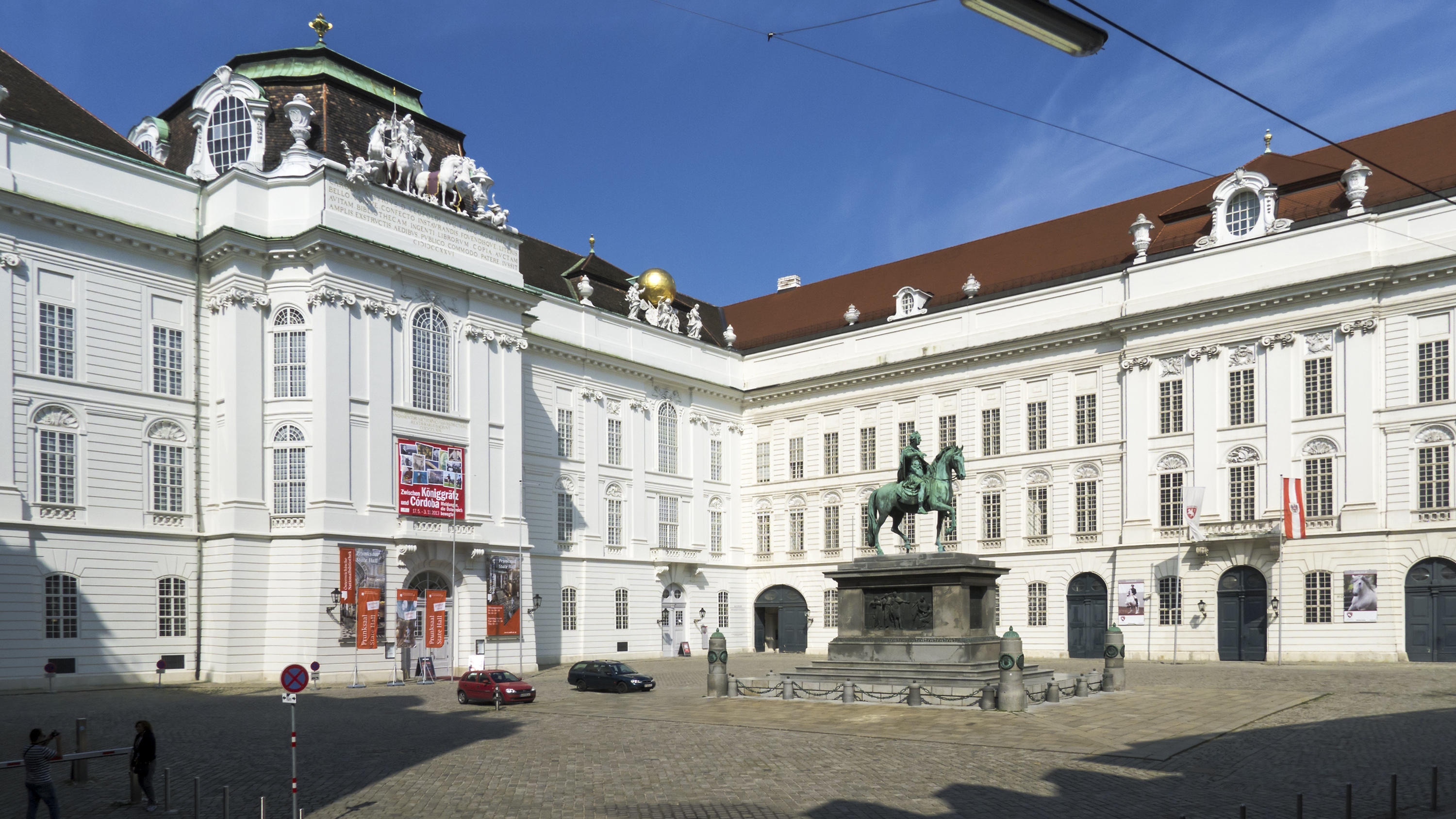
Josefsplatz is a public square at Vienna’s Hofburg Palace, named after Emperor Joseph II. Emperor Francis II commissioned its central equestrian statue, made by Franz Anton von Zauner from 1795 to 1807. The Stallburg and Pálffy Palace were built in the sixteenth century. The Stallburg was first built for Archduke Maximillian, then housed Archduke Leopold Wilhelm’s art collection from 1614 to 1662. Later converted into Hofburg stables, it once housed around 900 Lipizzaner horses and now accommodates the Spanish Riding School and Lipizzaner Museum.
The Redoutensäle joined the Hofburg complex from 1744 to 1748. The Pallavicini Palace was completed in 1784, designed by Ferdinand von Hohenberg in Baroque and Neoclassical styles. The square is enclosed on three sides by palace sections, including the Prunksaal, designed by Johann Bernhard Fischer von Erlach and his son. The Prunksaal serves as the Austrian National Library’s central structure and was also designed as a concert hall.
During the 1848 battle for Vienna, cannon fire destroyed the library museum’s zoological collection. In 1949, Josefsplatz featured in the film The Third Man. Fire badly damaged the Redoutensäle wing in 1992.
Zauner’s statue depicts Joseph II as a Roman conqueror, wearing a toga and laurel wreath. Its design was modelled on the statue of Marcus Aurelius on Rome’s Capitoline Hill. An Austrian five-euro commemorative coin minted in 2006 depicted the Hofburg Palace and Joseph II’s statue on its reverse.
Listen to this audio guide in the app
The website shows the text and photos. The audio guide, map and nearby places are in the free Hotspot app.
Download free on Google Play