
Canterbury Cathedral
Canterbury, United Kingdom of Great Britain and Northern Ireland (the)
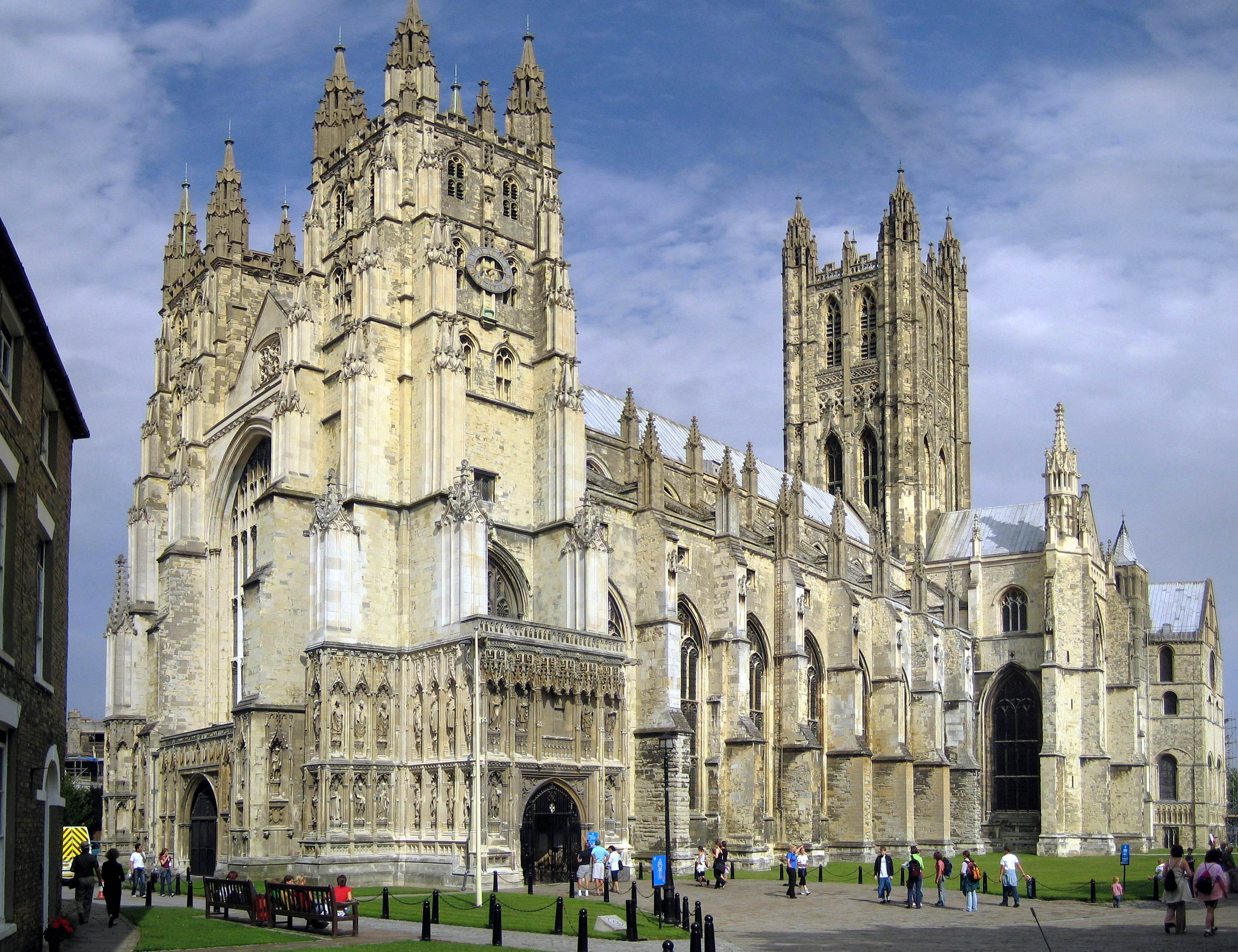
Canterbury Cathedral was founded in 597 by Augustine, who dedicated it to Jesus Christ, the Holy Saviour. It became the seat of the archbishop of Canterbury. Danish raids damaged the cathedral in 1011, and Archbishop Ælfheah was taken hostage. He was killed at Greenwich the following year. A Benedictine community developed at Christ Church Priory, becoming fully monastic during Lanfranc’s time.
Fire destroyed the cathedral in 1067, and Lanfranc began rebuilding it in 1070. His cruciform Norman church followed the design of the Abbey of Saint-Étienne in Caen, with an aisled nave, transepts and a short quire. The new church was dedicated in 1077.
Under Anselm, the east end was replaced with a much longer eastern arm. Ernulf began the work after becoming prior in 1096, and Conrad completed it by 1126. The expansion changed the church’s eastern plan before the events that reshaped it again.
On 29 December 1170, four knights murdered Archbishop Thomas Becket in the northwest transept. The place became known as the Martyrdom. Becket’s murder drew pilgrims seeking healing, and the cathedral was expanded to receive them.
A fire in September 1174 severely damaged the quire. William of Sens was appointed master mason to rebuild it, and William the Englishman later succeeded him. The Gothic work used pointed arches, rib vaults and flying buttresses, with Caen limestone and Purbeck marble among its materials.
Between 1180 and 1184, builders added the Trinity Chapel to house Becket’s shrine. His remains were moved there from his crypt tomb in 1220. The east end also gained the circular Corona, while stained glass, marble pavements and painted decoration adorned the rebuilt quire.
From the late fourteenth century, the Norman nave and transepts were demolished and rebuilt in the Perpendicular style. Master mason Henry Yevele oversaw the work, which included new piers and lierne vaults. This rebuilding gave the cathedral its present nave and transepts.
The central crossing tower, begun in 1433, became known as the Angel Steeple after a gilded angel stood on one of its pinnacles. In 1538, on Henry VIII’s orders, Becket’s shrine was removed and its treasures confiscated. They were carried away in two coffers and 26 carts.
On 30 March 1539, the cathedral and Christ Church monastery were surrendered to the Crown during the Dissolution of the Monasteries. The cathedral ceased to be an abbey and became a college of secular canons. Its new foundation came into being on 8 April 1541.
Around 1576, the crypt was granted to Canterbury’s Huguenot congregation for use as their Church of the Crypt. During 1642 and 1643, Puritan iconoclasts led by Edwin Sandys damaged the cathedral. They destroyed the statue of Christ at Christ Church Gate and demolished its wooden gates.
In 1660, workers restored the wooden gates, with other repairs continuing until 1704. The original Norman northwest tower had a lead spire until 1705. Structural concerns led to its demolition in 1834, when a Perpendicular-style tower was built in its place.
A fire in 1872 destroyed a large portion of the Trinity Chapel roof, though the stonework and interior suffered no significant damage. The roof was repaired. During the Second World War, bombing raids destroyed the cathedral library, but local Fire Wardens extinguished flames on the wooden roof and limited damage to the building.
A new Martyrdom Altar was installed in the northwest transept in 1986. Restoration of the lead roof over the transept was completed in 2008, and the nave’s lead roof was replaced in 2018. The organ was expanded and rebuilt from 2018 to 2020, with the work finishing in February 2020.
The cathedral has five towers, three of which contain 21 bells, and its central crossing tower reaches 72 metres. Its library holds about 30,000 books and pamphlets printed before the twentieth century, along with about 20,000 later books and serials. The chapter house still exists and is described as England’s largest of its kind.
Canterbury Cathedral remains a centre of worship and the ceremonial seat of the archbishop of Canterbury. Its choir includes up to 25 boy choristers and 12 lay clerks and choral scholars, with seven choral services each week. The cathedral also serves as a graduation venue for the University of Kent and Canterbury Christ Church University.
The cathedral forms part of a World Heritage Site with St Augustine’s Abbey and the ancient Church of St Martin. Pilgrims’ income helped fund rebuilding and associated buildings, and badges depicted Becket, his martyrdom or his shrine. Geoffrey Chaucer’s Canterbury Tales includes pilgrims visiting the shrine. Polyphonic music written for the monks of Christ Church Priory survives from the thirteenth century. The cathedral maintains a choral tradition described as 1,400 years old.
Listen to this audio guide in the app
The website shows the text and photos. The audio guide, map and nearby places are in the free Hotspot app.
Download free on Google Play