
Boyana Church
Sofia, Bulgaria
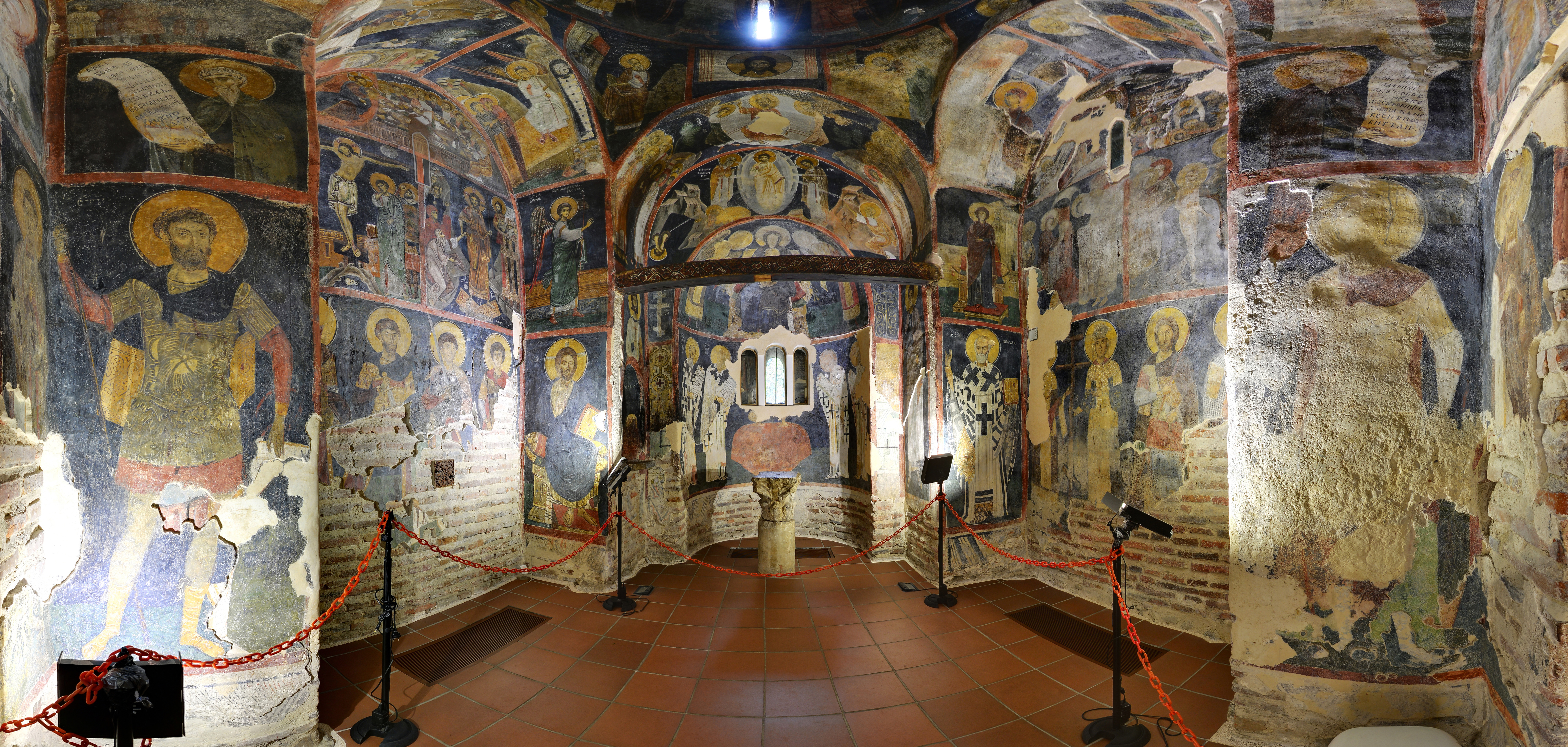
Boyana Church is a medieval Bulgarian Orthodox church whose oldest eastern section dates from the late tenth or early eleventh century. It grew in three stages, with a central section added in the thirteenth century and a western expansion in the nineteenth. The eastern church is small, with one apse, a cross-vaulted ceiling and built-in cruciform supports. Its dome depicts Christ Pantocrator, while angels appear on the drum below. The central section was commissioned in the mid-thirteenth century by Sebastocrator Kaloyan and his wife Desislava.
That central section is a two-floor tomb-church, with a family sepulchre below and a chapel above. Ceramic ornaments decorate its exterior. A donor inscription names Kaloyan and states that the church was decorated in 1259 under Tsar Constantine Asen.
The 1259 paintings form a second layer over earlier frescoes. They include portraits of Kaloyan and Desislava, as well as Tsar Constantine Tikh and Tsaritsa Irina. The older layer dates from the eleventh and twelfth centuries, and fragments survive in parts of the eastern church.
The narthex contains eighteen scenes from the life of Saint Nicholas. Other paintings date from the fourteenth century, the sixteenth and seventeenth centuries, and 1882. In the mid-nineteenth century, donations from the local community funded the church’s western expansion.
Austrian and Bulgarian specialists restored and cleaned the frescoes from 1912 to 1915. Further work followed in 1934 and 1944. In 1954, the church closed for conservation and restoration.
The church reopened partially in 2006. During restoration work from 2006 to 2008, workers uncovered an inscription that may read “I, Vasiliy inscribed.” Whether Vasiliy was the Boyana Master or an assistant remains disputed.
On October 2, 2008, Culture Minister Stefan Danailov fully reopened the church. The National Historical Museum manages it, and protective measures include controlled temperature and low-heat lighting. The walls contain eighty-nine scenes and two hundred forty human images. In 1979, Boyana Church was added to the UNESCO World Heritage List.
Its 1259 frescoes are regarded as exceptional achievements of medieval Bulgarian culture. They are also described as having played an important role in the development of medieval Bulgarian and European painting. Boyana Church is described as the only wholly preserved monument of the thirteenth-century Turnovo School of Painting. Its frescoes are among the most complete and well-preserved monuments of medieval art in the Balkans.
Listen to this audio guide in the app
The website shows the text and photos. The audio guide, map and nearby places are in the free Hotspot app.
Download free on Google Play