
Christiansborg Palace
Copenhagen, Denmark
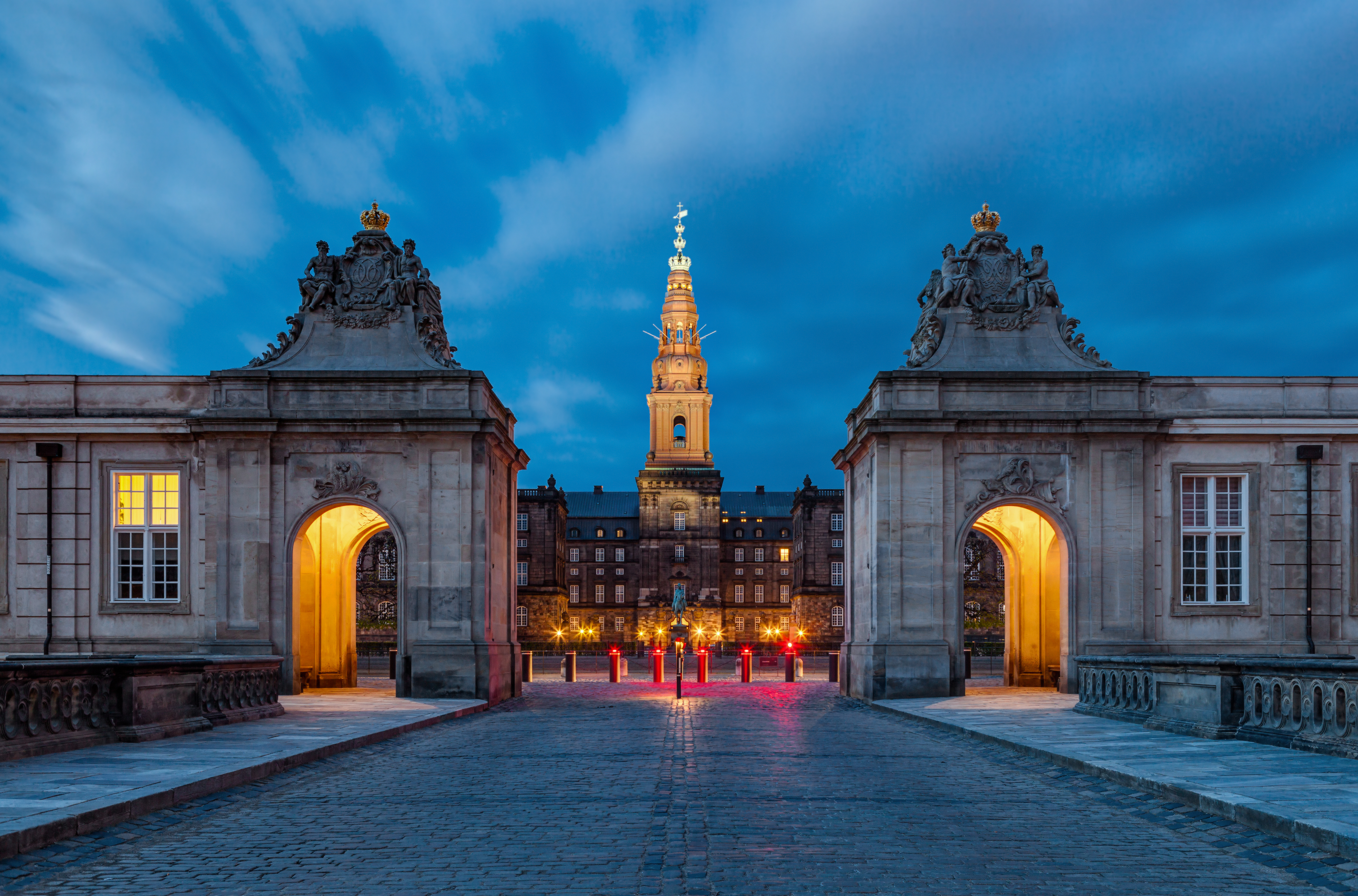
Christiansborg Palace is a palace and government complex in Copenhagen, built on a site where Bishop Absalon founded a castle in 1167. Denmark’s Parliament, Supreme Court and Prime Minister’s Office now occupy parts of the palace, while the Royal House uses other rooms. Absalon bequeathed his castle to the See of Roskilde in 1182, reserving use for his lifetime. After his death in 1201, it passed to the see, and control of the castle and town later shifted between bishops and kings. The Hanseatic League captured and demolished the castle in 1368 and 1369.
A successor, Copenhagen Castle, remained owned by the bishops of Roskilde until King Eric of Pomerania took it for the crown in 1417. It became a royal residence in 1443 and, from the mid-fifteenth century, the principal royal residence and seat of government. Its old foundations eventually began to fail during extensive rebuilding.
Christian VI commissioned the first Christiansborg because Copenhagen Castle had become cramped and dark. The old castle was demolished in 1731, and Christian VI laid the new palace’s foundation stone in 1733. Designed by Elias David Häusser, it was a six-level Rococo palace with four wings, riding grounds and a chapel.
The first palace was ready for habitation in 1740, and the royal family moved in that November. Its construction cost more than half the kingdom’s annual income, according to the comparison recorded for the project. The palace’s lavish scale did not protect it from fire.
On 26 February 1794, a chimney fire in the main wing destroyed Christiansborg and its chapel. Crowds worked to save the palace and its contents, as well as neighboring districts, from falling embers. Furnishings and artworks were extensively lost in the fire.
Plans for a replacement were delayed after the 1794 fire and another fire in Copenhagen the following year. C.F. Hansen designed the second Christiansborg, reusing much of the surviving exterior walls and interior partitions. The Classical palace was inaugurated in 1828, but the royal family preferred Amalienborg and used it mainly for representation and guest accommodation.
Frederick VII began using the second palace more fully after becoming king in 1848, gathering the court administration there. In March, a procession assembled in front of Christiansborg during Denmark’s transition from absolute monarchy to constitutional government. After the monarchy’s absolute powers ended, the palace became state property, though the king retained use rights and responsibility for interior maintenance.
The king ceded much of the palace to the Rigsdag, which began working there in January 1850. The second Christiansborg burned on 3 October 1884 after a stove fire near the Rigsdag chamber. Firefighters could not save the palace, but rescued the chapel and riding-ground complex; much of the interior, archives, books and silverware had already been removed.
The plan for a third palace provoked arguments over combining royal representation with parliamentary work. Members of the Rigsdag objected to being guests in a king’s palace, while architects argued that the functions required separate buildings and styles. After competitions and disputes, Thorvald Jørgensen’s design was adopted in 1906.
Construction began that autumn on the predecessors’ foundations, partly using their exterior walls. Bricklayers’ laborers struck in 1910, and further stoppages involved bricklayers and electricians. The foundation stone had been laid in 1907, but the palace was formally transferred to the state only in December 1927.
The king began using the Royal Representation Rooms in January 1928, when the third palace was officially considered complete. Its Folketing chamber had been inaugurated in 1918 and held its first meeting on 28 May. The Supreme Court began using rooms in the palace in 1919.
Thorvald Jørgensen’s design developed into a three-winged, Neo-Baroque building, with curved projections, granite facades and a mansard roof. The palace has six floors, with principal rooms on the first floor. The Folketing occupies the south wing, while the royal rooms are in the north wing; the Supreme Court and Prime Minister’s Office also occupy parts of the complex.
More than 700 Danish parishes contributed granite for the ground and basement floors, giving their surfaces varied colors and rough textures. Sandstone from the previous palace was reused on lower floors in Prince Jørgen’s Courtyard, and Anders Bundgaard produced most of the facade stone carving. Granite masks appear above many ground-floor windows.
The Folketing chamber extends through three floors, with horseshoe-shaped seating and oak wall panels. Four granite figures support the balcony above the entrance; their distressed expressions prompted a fund to remove them, but they remain. In 1934, a weather vane and two additional crowns were added to the tower.
The Palace Chapel, saved from the 1884 fire, was damaged again on 7 June 1992. A rescue flare fired during the Whitsun carnival caused a fire that burned the roof and significantly damaged the interior and walls. The chapel was reconstructed to its pre-fire appearance and reconsecrated by Queen Margrethe in 1997.
The Great Hall received its tapestries in 2000, based on designs by Bjørn Nørgaard. It is used for receptions and gala dinners connected with state visits, and can seat about 400 dining guests. The Royal Representation Rooms host official functions, including receptions, audiences and Council of State meetings.
Christiansborg’s tower reaches 106 metres, and is described as the tallest in Copenhagen. The Royal House continues to use the Representation Rooms, Chapel and Stables, while the palace also houses Denmark’s central political and judicial institutions. Its grounds retain structures from earlier palaces, including surviving riding-ground buildings and walls incorporated into the current complex.
Listen to this audio guide in the app
The website shows the text and photos. The audio guide, map and nearby places are in the free Hotspot app.
Download free on Google Play