
Walls of Constantinople
Istanbul, Turkiye
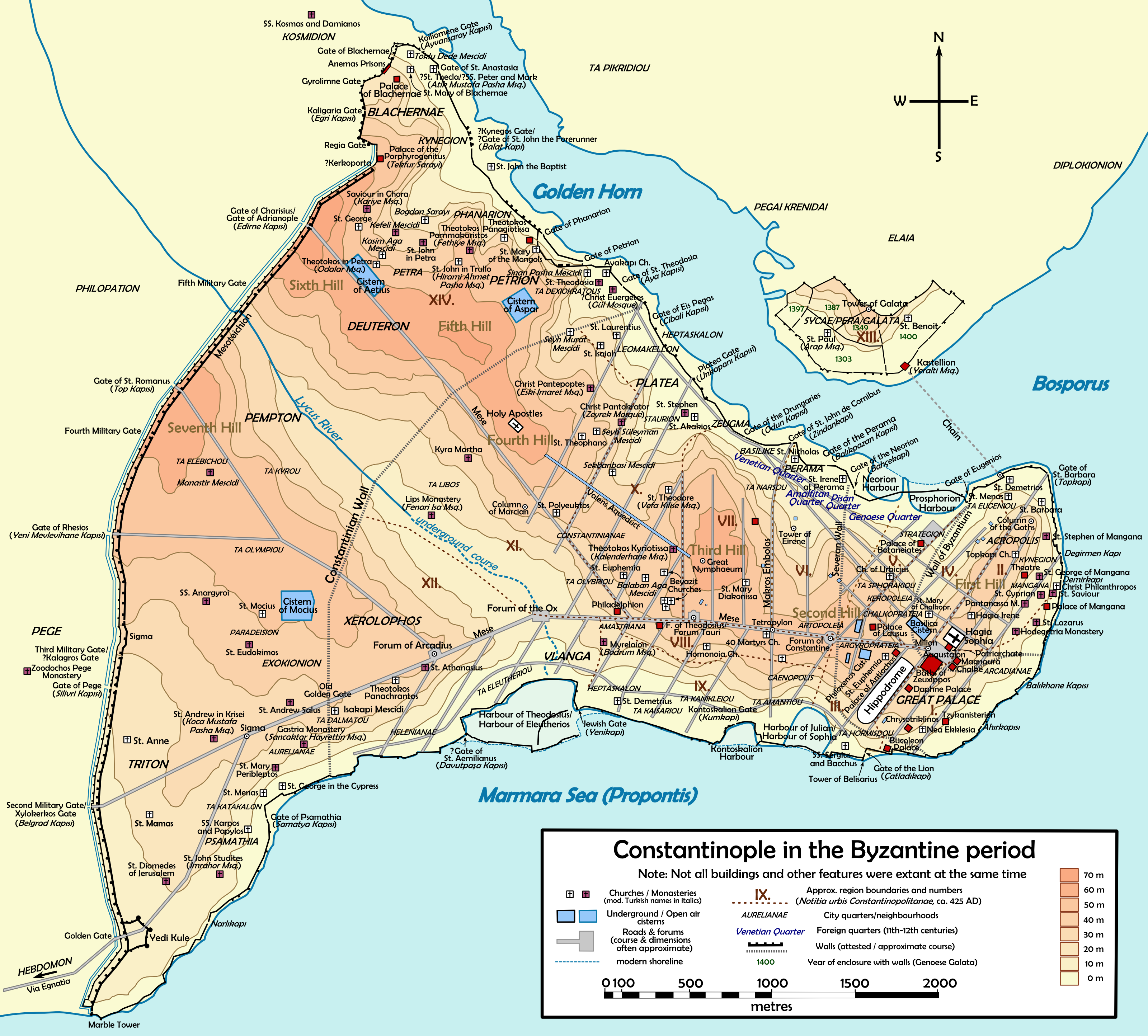
The Walls of Constantinople are land and sea fortifications built around Constantinople from the fifth century onward. The first phase of the Theodosian Walls began around 404 or 405, during the reign of Arcadius. Under the direction of the prefect Anthemius, that first phase was completed in 413. The land defenses had a moat, an outer wall, and an inner wall, with a terrace between each line. The inner wall used cut limestone around a core of lime and crushed-brick mortar, crossed by bands of brick.
An earthquake severely damaged the walls on 25 September 437. In 439, city prefect Cyrus of Panopolis was ordered to repair the land walls and complete their seaward side. The Golden Horn entrance was guarded by a heavy chain supported on floating barrels, attached to towers on either shore.
On 6 November 447, an earthquake destroyed large sections of the walls, including 57 towers. Another major earthquake struck in January 448. Theodosius II ordered the prefect Constantine to oversee repairs, and the work was completed in 60 days with labor from the city’s racing factions.
Earthquakes and floods of the Lycus River continued to damage the defenses, prompting further repairs. An official known as the Count of the Walls or Domestikos was responsible for the work, drawing on labor from the city’s people. The Golden Gate, on the land walls at Yedikule, served as a ceremonial imperial entrance.
After the Fourth Crusade, the Venetians breached the sea defenses. The walls fell into disrepair after the Latin conquest in 1204, and the restored Byzantine state after 1261 lacked resources to maintain them except when immediate threats arose. Michael VIII later strengthened and raised the sea walls in response to a possible invasion by Charles of Anjou.
The sea walls were restored in the early eighth century, by either Tiberios III or Anastasios II. Michael II began extensive renovations, and his successor Theophilos completed them while raising the walls. Along the landward defenses, the inner and outer walls, moat, and towers formed a system reported to be 70 metres wide.
Galata’s walls were extended northward in 1349, then extended again in 1387, 1397, and 1404. A new fortress at Yedikule was built in 1350. In 1422 and 1453, defenders and their allies concentrated on the outer land wall because they lacked enough forces to hold both lines.
Mehmed II rebuilt Yedikule as a seven-tower fortress in 1457. The fortress later served as an Ottoman treasury and a place of confinement for senior officials. In 1622, Janissaries killed Osman II at Yedikule.
The land walls and towers remained present throughout the Ottoman period, though many sections are now ruined or close to collapse. Many surviving main-wall towers were rebuilt during Byzantine or Ottoman times, and later alterations often made their roofs fighting platforms. The moat became agricultural land.
The walls enclosed Constantinople along the Golden Horn, the Marmara Sea, and the western landward side. The general description gives the full system a length of 22 kilometres, while a later passage gives 20 kilometres. The reported section lengths are 5.5 kilometres along the Golden Horn, 7.5 kilometres on land, and 9 kilometres beside the Marmara Sea.
The principal land wall had 96 towers, mostly square, with some polygonal examples. The Golden Gate had gilded gate leaves installed after a victory in 425, along with statues of Theodosius and Nike, an elephant-drawn chariot, and inscriptions in gilded bronze. From at least 411, the walls were a landmark for travelers approaching Constantinople by land or sea. Travel accounts described the land defenses as exceptionally strong. Abbot Martin compared the proximity of the towers to a child throwing an apple from one tower to the next. The Golden Gate was associated with imperial victory processions and formal entries into the capital. The route from the Via Egnatia reached the gate and continued inside the city along the Mese.
Listen to this audio guide in the app
The website shows the text and photos. The audio guide, map and nearby places are in the free Hotspot app.
Download free on Google Play