
Fort Stanwix
Rome, United States of America (the)
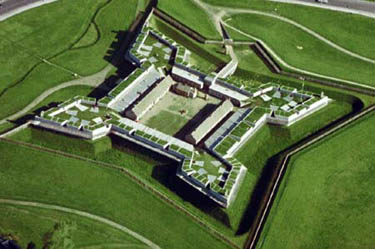
Fort Stanwix was a colonial bastion fort built to guard the Oneida Carry, a portage between waterways. British General John Stanwix began construction in 1758, and the fort was completed about 1762.
The portage linked routes toward the Atlantic through the Mohawk and Hudson rivers with routes to Lake Ontario. In 1768, William Johnson arranged a treaty conference between Britain and the Iroquois. Signed on November 5, the treaty extended the boundary westward, and the Iroquois ceded Kentucky. The Shawnee, Delaware, and Cherokee, who primarily used those lands, had no role in the negotiations. The fort was abandoned that year and fell into ruin.
Colonel Elias Dayton’s troops reoccupied the fort in 1776 and began rebuilding it as Fort Schuyler. Colonel Peter Gansevoort took command in May 1777, before British Brigadier General Barry St. Leger’s force began a siege in August. The defenders refused to surrender as the besiegers awaited news from the Battle of Oriskany and a reported relief column led by Benedict Arnold. While many besiegers were away at Oriskany, defenders sallied out, attacking their camp and looting and destroying its stores.
The besiegers eventually withdrew, and the fort remained a military position until it burned to the ground in 1781. It was not rebuilt, and its garrison moved to Fort Herkimer. In 1779, Continental Army forces led by Colonel Goose Van Schaick had launched an expedition from Fort Schuyler against the Onondaga people. A second Treaty of Fort Stanwix was conducted at the site in 1784. During the War of 1812, a blockhouse stood on the parade ground, and dismantling of the fortifications began in 1828.
Legislation creating Fort Stanwix National Monument was signed in 1935, when businesses and residences occupied the land intended for it. Rome leaders promoted reconstruction during urban renewal in the 1960s. After a master plan and a three-year archaeological investigation beginning in 1970, reconstruction began in 1974. The partial fort opened in 1976 for the United States Bicentennial, and the present reconstruction was completed in 1978.
The National Park Service reconstruction is clad in earth and timber around three freestanding buildings, with a reinforced-concrete structure. Three short trails encircle the monument, and one follows part of the Oneida Carry. Its collections center preserves 485,000 artifacts and documents and presents exhibits on the fort and the Mohawk Valley.
The successful defense helped halt the British advance down the Mohawk Valley and contributed to General John Burgoyne’s defeat at Saratoga. Local folklore claims a flag raised over the fort on August 3, 1777, was the first United States flag flown in battle. It was more likely a thirteen-stripe flag, an early version of the Flag of New York, or the Continental Union Flag.
Listen to this audio guide in the app
The website shows the text and photos. The audio guide, map and nearby places are in the free Hotspot app.
Download free on Google Play