
St. Mark's Church in-the-Bowery
New York City, United States of America (the)
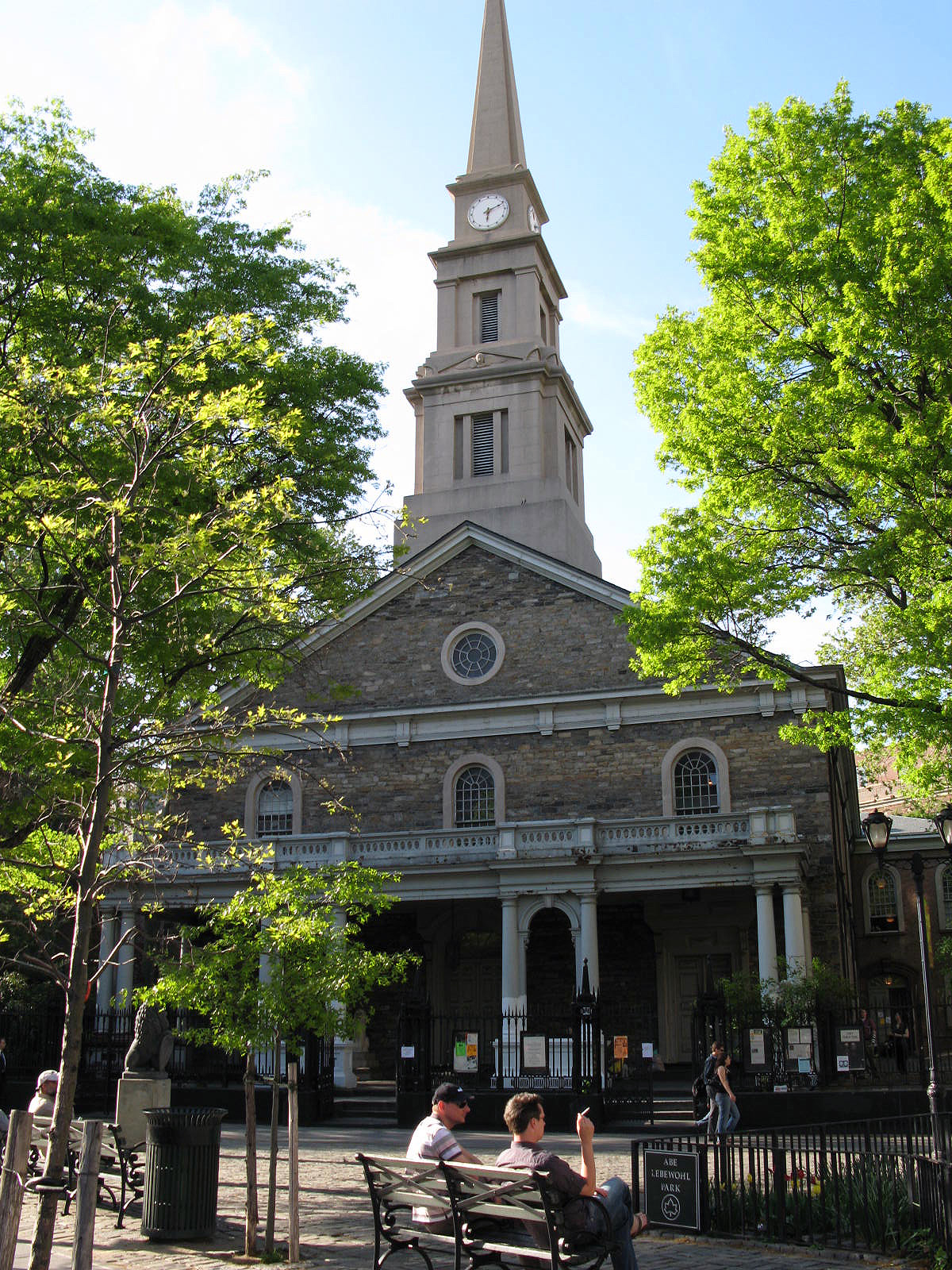
St. Mark’s Church in-the-Bowery is an Episcopal parish on land Petrus Stuyvesant purchased in 1651. By 1660, he had built a family chapel on the site.
After Stuyvesant died in 1672, he was buried in a vault beneath the chapel. In 1793, his great-grandson sold the property to the Episcopal Church for one dollar, stipulating that a new chapel serve Bowery Village. The cornerstone of the present church was laid in 1795.
John McComb Jr. built the fieldstone Georgian-style church, completed and consecrated in 1799. Alexander Hamilton provided legal aid to incorporate it as New York City’s first Episcopal parish independent of Trinity Church. A Greek Revival steeple followed in 1828.
Work on a stone Parish Hall began in 1835, and a year later the church’s square pillars were replaced with thinner Egyptian Revival-style ones. A cast-iron portico was added around 1858, and the fence followed in 1838. In 1861, the Parish Hall gained a brick addition, and members organized the St. Mark’s Hospital Association.
The church’s artistic activity expanded in the twentieth century. Poet Kahlil Gibran joined the St. Mark’s Arts Committee in 1919, giving readings and exhibiting drawings. In 1920, Solon Borglum’s statues Aspiration and Inspiration were unveiled beside the entrance.
Theatre Genesis was founded at the church in 1964, where Sam Shepard’s plays Cowboys and Rock Garden were produced. The Poetry Project and The Film Project, later called the Millennium Film Workshop, were founded there in 1966. In 1969, the Mind Garage performed the Electric Liturgy, described as the first nationally televised work to fuse liturgy and experimental rock music.
In November 1971, Patti Smith read poetry at the church, accompanied by Lenny Kaye on guitar. The reading launched their rock-and-roll careers and marked the founding of the Patti Smith Group. A fire nearly destroyed the church on July 27, 1978.
Citizens to Save St Mark’s formed to raise reconstruction funds after the fire. The Preservation Youth Project undertook the work under architect Harold Edelman, with craftspeople from preservation contractor I. Maas and Sons. Restoration was completed in 1986 with new stained-glass windows designed by Edelman.
In 2020, the church reported 103 members and average attendance of 67. The church and rectory have also hosted preservation groups and organizations devoted to poetry, film, dance, and theater. Isadora Duncan danced at the church in 1922, and Martha Graham performed there in 1930.
Listen to this audio guide in the app
The website shows the text and photos. The audio guide, map and nearby places are in the free Hotspot app.
Download free on Google Play