
Castle Clinton
New York City, United States of America (the)
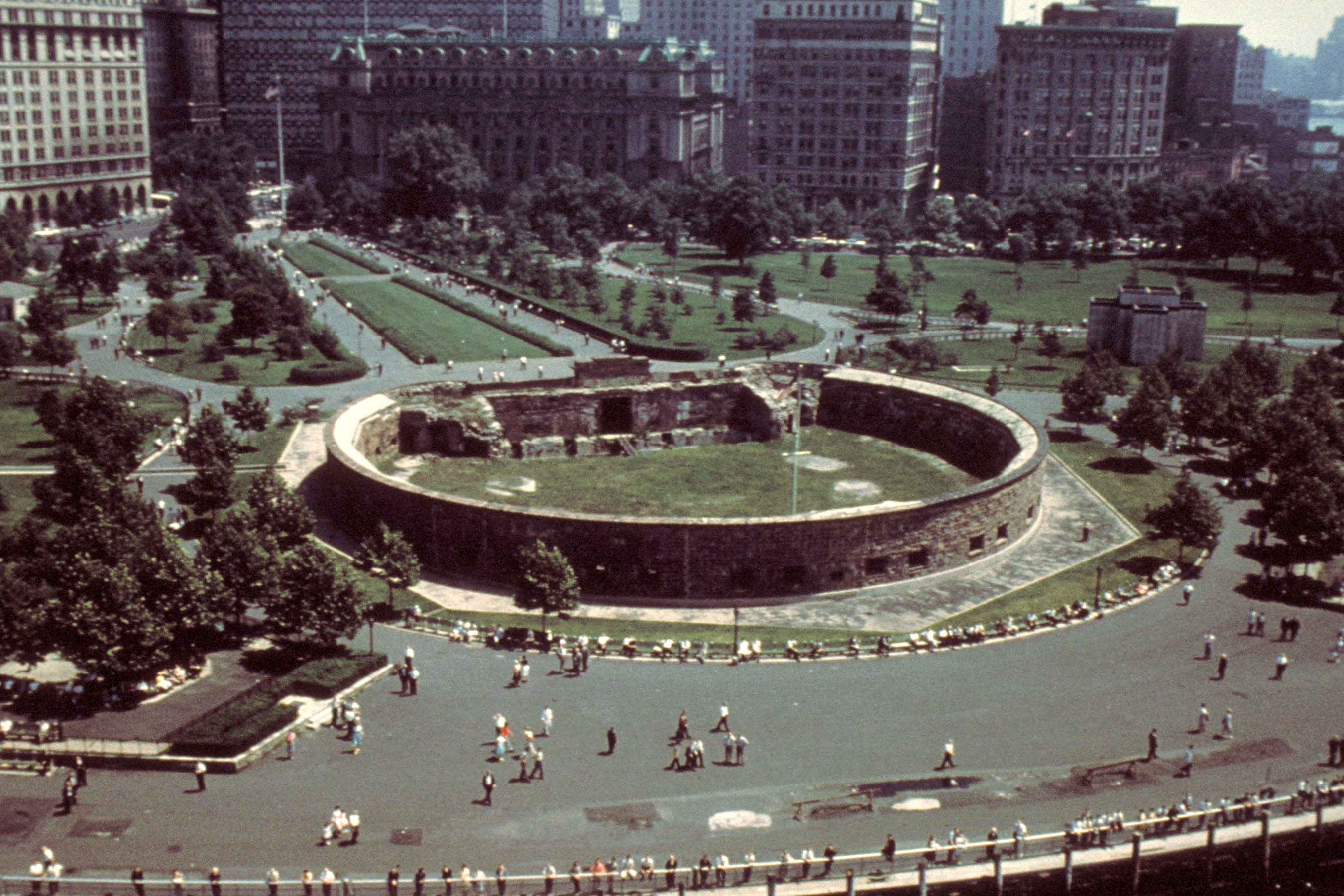
Castle Clinton is a circular sandstone fort built from 1808 to 1811 on an artificial island off Lower Manhattan. John McComb Jr. designed it, with Lieutenant Colonel Jonathan Williams as consulting engineer. After proposals for harbor defenses in the 1790s, rising tensions with Britain prompted Williams to plan defenses for New York Harbor in 1805. The fort was intended to complement Castle Williams on Governors Island, and a wooden bridge connected it to Manhattan. Its red sandstone walls came from quarries in New Jersey.
Garrisoned in 1812, the fort was never used for warfare. The Army stopped using it in 1821, and Congress ceded it to New York City the following year. The city leased it as an entertainment venue, and Castle Garden opened on July 3, 1824.
In September 1824, 6,000 people gathered at Castle Garden for an event honoring General Lafayette. The venue held performances and public events, including a telegraph demonstration by Samuel Morse in 1835. Jenny Lind gave her first United States performances there in 1850.
The entertainment venue became an immigrant landing depot in 1855. New York State’s Board of Emigration Commissioners opened the Emigrant Landing Depot on August 1, and processing began two days later. The rotunda held waiting space, registration desks, benches, restrooms and an enclosed balcony.
Immigrants were medically inspected at the Marine Hospital on Staten Island, then inspected again at Castle Garden and registered. Staff advised them about destinations and directed them to collect baggage, while railroad companies sold tickets inside. Late in the depot’s operation, reports described overcrowding, unhygienic conditions and mistreatment by officials.
Castle Garden processed either 7.5 million or 8 million immigrants, according to differing cited figures. The depot closed on April 18, 1890, after federal officials chose Ellis Island for a new immigration center. The state formally transferred Castle Garden to the city on December 31 that year.
The fort became the New York City Aquarium, which opened on December 10, 1896, after a soft opening the previous day. Its conversion roofed and altered the fort, adding several stories, circular colonnades and a skylighted roof. A green-and-yellow dome bore a verse from Habakkuk.
The aquarium’s opening day drew thousands of visitors, and attendance averaged over 10,000 daily during its first several months. Its construction faced problems: skylights overheated the tanks, while low Hudson River salinity caused saltwater fish to die. The aquarium closed in 1941, and some fish and turtles moved to other aquariums; other fish were released into the Atlantic.
After the aquarium closed, Robert Moses proposed demolishing the fort during plans for the Brooklyn-Battery Tunnel. Preservation campaigns and disputes over ownership continued for years. A federal law designated Castle Clinton a national monument in 1946, after the fort had been partially dismantled.
New York City deeded the fort and its land to the federal government on July 18, 1950. The monument was formally dedicated that October. The National Park Service began exterior restoration in 1952 and reconstructed the original door.
Major restoration began in 1968, followed by a wider project around 1972. Workers restored the walls, roof, parade ground and officers’ quarters, and placed an exhibit in a former powder magazine. The work removed aquarium facilities, including a moat.
Castle Clinton reopened on May 25, 1975, after extensive renovation, and city and federal officials rededicated it the following month. Its restored form is a one-story structure, with an open-air parade ground surrounded by an eight-foot-thick wall. Removing the stucco restored its brownstone-and-ashlar exterior.
A portico with wooden columns follows the fort’s circumference, and the grounds include a gravel courtyard and brick powder magazines. Two underground water tanks lie beneath wooden trapdoors. The fort reopened in 1986 as a visitor center and ferry ticket office for the Statue of Liberty National Monument.
According to the National Park Service, Castle Clinton typically receives over three million visitors a year. The Battery Conservancy is also housed in the fort. The immigrant depot was the first immigration station in the United States, and the New York Times estimated in 2005 that one-sixth of Americans descended from someone who passed through Castle Garden. German immigrants and Yiddish-speaking Eastern European Jews pronounced Castle Garden as Kesselgarten. The word became a generic term for a noisy, confusing situation or a babel of languages.
Listen to this audio guide in the app
The website shows the text and photos. The audio guide, map and nearby places are in the free Hotspot app.
Download free on Google Play