
La Madeleine, Paris
Paris, France
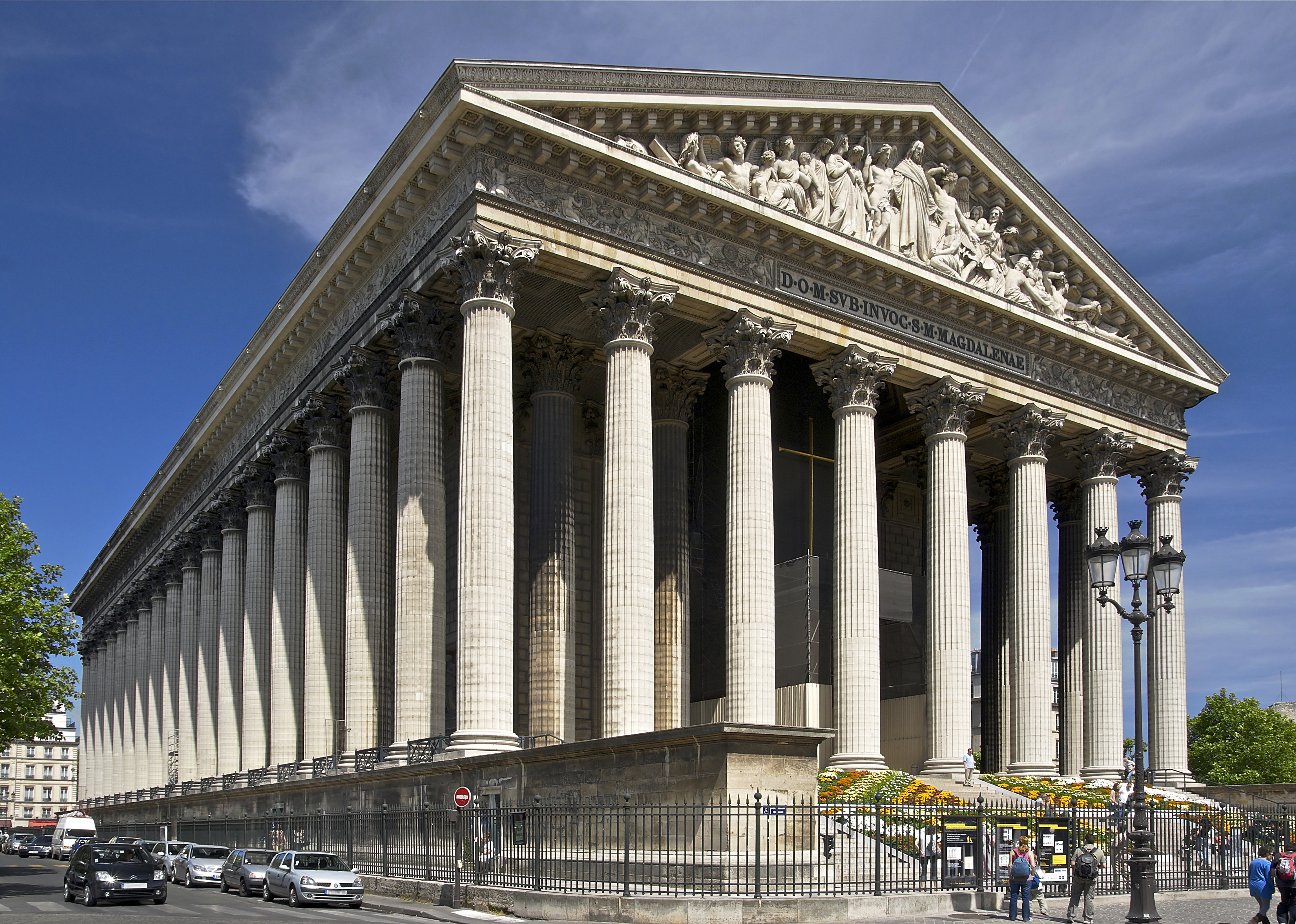
The Church of the Madeleine is a neoclassical Roman Catholic church whose construction began in 1763. Its plans changed repeatedly, from a parish church to a temple for the French armies and back again. In 1722, the faubourg of Ville l’Évêque was annexed to Paris, and its old Madeleine church was considered too small. A new church was planned as part of wider development around the future Rue Royale. Pierre Contant d’Ivry received the design commission in 1757, and Louis XV laid the first stone in 1763. The original plan, approved in 1764, had a Latin-cross layout and a small dome.
After Contant d’Ivry died, Guillaume-Martin Couture revised the design as a Greek-cross church with a larger dome and Corinthian portico. Then, on 30 December 1791, a decree halted construction amid the French Revolution. The unfinished building was considered for other purposes, including a national palace, the National Library, an opera house, and commercial institutions. None of those proposals became its lasting use.
On 2 December 1806, Napoleon I chose a temple design by Pierre-Alexandre Vignon to celebrate the French armies. A competition for the design involved 80 artists, and the selected exterior took the form of a Greco-Roman temple. Work continued until lack of funds stopped it in 1811. After the Russian campaign in 1812, Napoleon returned the project to its original purpose as a church.
Louis XVIII later intended the building as an expiatory monument to Louis XVI, Marie Antoinette, and Madame Élisabeth. That intention affected the decoration, but not the plan. Vignon died in 1828 before construction was complete, and Jean-Jacques-Marie Huvé took charge. Huvé designed the interior, drawing on ancient Roman baths and the polychrome decoration of the Pantheon in Rome. A commission replaced six planned nave lunettes with openings in three cupolas, a decision Huvé criticized; his drawings showed a brighter interior.
In 1830, after the Revolution, Louis-Philippe confirmed that the building would be a church rather than a railway station, specifying that it would serve as a parish church. The sculptor Philippe Joseph Henri Lemaire completed the pediment in 1833, depicting the Last Judgment. A public-works allocation in 1834 helped fund the remaining construction. The building was completed in 1842, and the Church of the Madeleine was consecrated in 1845.
Its final exterior has an octastyle portico and a colonnade of 52 Corinthian columns, each 20 metres high. The design is described as a near reproduction of the Olympieion in Athens. Inside, paintings, sculpture, mosaics, metalwork, and goldsmithing formed part of a broad decorative program. More than 60 artists and craftspeople contributed to the church’s artistic works.
The church’s musical life has included two organs built by Aristide Cavaillé-Coll. He built the choir organ in 1843 and the grand organ in 1846. The grand organ now has four keyboards and 60 stops. Gabriel Fauré served as chapel master from 1877 to 1896, followed by Théodore Dubois from 1868 to 1877, as listed for the same role.
Structural problems prompted extensive restoration work more than a century and a half after construction. Scaffolding has supported the building since 1998, and a danger order was issued in 2011. Pollution had covered statues, carved decoration, and paintings with a dark, greasy layer. A restoration fund was established in 2015, and the City of Paris committed 10 million euros in 2021 to work on the façade facing Rue Royale.
A test column revealed unexpected metal structures inside the stone, while a possible full-building restoration was estimated to cost 80 million euros. Private donations funded the chandelier renovation, completed in early 2023. The Church of the Madeleine remains a Roman Catholic parish church and a major example of neoclassical architecture in Paris.
Listen to this audio guide in the app
The website shows the text and photos. The audio guide, map and nearby places are in the free Hotspot app.
Download free on Google Play