
Palais Garnier
Paris, France
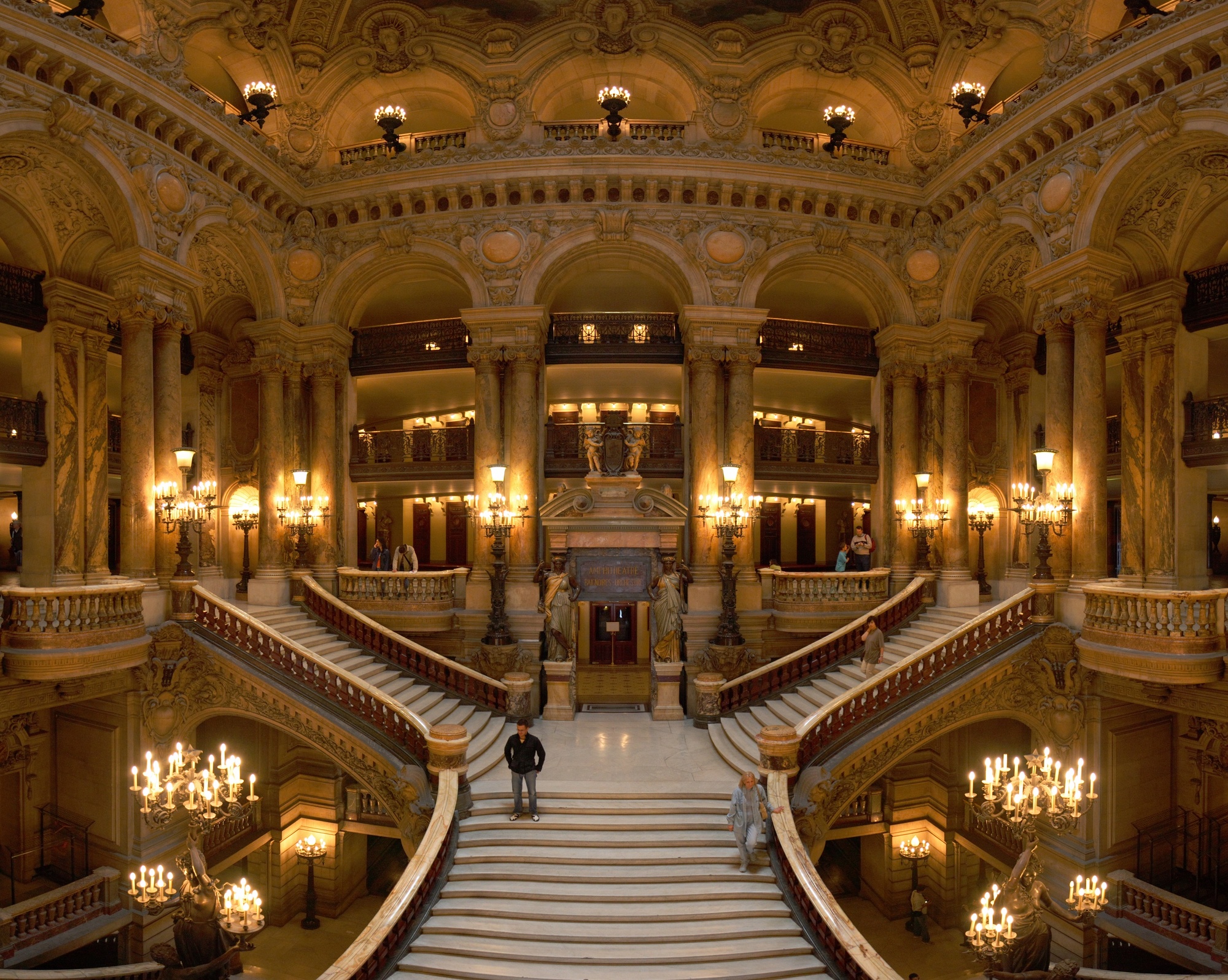
The Opéra Garnier is a Paris opera house commissioned after an assassination attempt on Napoleon III in 1858. Architect Charles Garnier won its design competition in 1861. The emperor wanted a new opera house at a site considered less vulnerable to attack. The project became a public utility in 1860, and 171 candidates entered the competition. Garnier won unanimously on 30 May 1861 with a design that joined aesthetic ambition to technical innovation.
Construction began in 1861, and officials laid the first stone on 5 May 1862. Excavation encountered groundwater, so builders used a cofferdam and steam pumps. Beneath the stage house, the resulting basin helped support the building and later served as a reservoir for fire water.
Garnier adapted a broadly symmetrical plan to a diamond-shaped, asymmetrical site. The exterior distinguishes the auditorium, stage house and administrative areas through separate volumes. Its eclectic design combines historicist styles, with a strong Baroque influence, and uses Euville stone, colored marble, iron and gilded surfaces.
On 15 August 1867, the completed main façade was provisionally inaugurated during the Exposition Universelle. Empress Eugénie criticized its style, and Garnier replied that it was in the style of Napoleon III. Sculptural groups on the façade represent poetry, instrumental music, dance and lyric drama.
Jean-Baptiste Carpeaux’s sculpture Dance drew public disapproval. In 1869, an unknown person threw an inkwell at the group. The façade’s sculptural program remained part of the building’s varied decoration, which also included gilding, mosaics and colored stone.
Funding limits and political upheaval repeatedly slowed construction. Work stopped during the Franco-Prussian War, when unfinished parts were requisitioned for military provisions and straw for horses. The Paris Commune also damaged the building, and repairs were needed before work could continue.
The old Le Peletier opera house burned in October 1873, and funds were finally assembled to complete the new one. The Opéra Garnier was delivered on 30 December 1874, at a cost of 36 million gold francs. The Glacier rotunda and Fumoir gallery remained unfinished.
The opera house was inaugurated on 5 January 1875 before President Patrice de Mac-Mahon and nearly 2,000 guests. The programme included music by Auber, Halévy, Rossini, Meyerbeer and Delibes. Afterward, the press mocked the administration for making Garnier pay for a seat at the opening, though accounts differ on whether he had been invited.
The auditorium has a horseshoe plan, four balconies and seating on five levels. Its original ceiling painting by Jules-Eugène Lenepveu remains beneath a removable structure carrying Marc Chagall’s design, installed in 1964. A large bronze-and-crystal chandelier hangs above the auditorium.
On 20 May 1896, a 750-kilogram chandelier counterweight fell through the ceiling during a performance of Hellé. It killed audience member Claudine Chomeil and injured others during the ensuing panic. The chandelier itself did not fall.
In 1910, the Seine flood reached the underground cellars and damaged heating equipment, electrical networks and stage machinery. The stage house later caught fire on 13 September 1936. Firefighters extinguished it, and the building closed for repairs before reopening on 20 February 1937 with Lohengrin.
The stage house includes five levels below the stage, wings, a fly system and three overhead grids. Italian-style machinery moves scenery and performers. The grand staircase, with varied marbles, onyx handrails, mosaics, paintings and gilding, forms another central part of Garnier’s design.
During the German occupation in the Second World War, performances continued under difficult conditions. The theatre was sometimes unheated, and the authorities required the Berlin Philharmonic orchestra to perform there. The building continued to serve as an opera and ballet venue.
In 1987, the dance school moved from the Palais Garnier to a purpose-built building in Nanterre. Former school rooms were adapted for rehearsals and daily classes for the ballet company. When the Opéra Bastille opened in 1989, the former Paris Opera became known as the Opéra Garnier or Palais Garnier.
A major restoration campaign began in 1990, covering the stage, auditorium, main façade and Grand Foyer. The façade was cleaned and restored in 2000, recovering its polychromy and gilding. Restoration of the Grand Foyer’s decoration and textiles followed in 2004, alongside work on electrical networks.
A restaurant opened in the covered carriage entrance in 2011. The former subscribers’ entrance had been designed for annual subscribers who rented boxes. A later campaign to restore the main façade began in April 2023 and was scheduled to continue through the end of 2024.
The Opera Library-Museum preserves nearly 600,000 documents and a collection of 8,500 museum objects. The Palais Garnier has been classified as a historic monument since 1923. It is part of the Opéra national de Paris, together with the Opéra Bastille.
The building is associated with the Ballets Russes seasons and with works created there, including Maurice Ravel’s Boléro in 1928. André Messager’s Les deux pigeons was created there in 1886, and Igor Stravinsky’s Le Baiser de la fée followed in 1928. Roussel’s Bacchus et Ariane was created there in 1931.
A legend places a subterranean lake beneath the stage house, supposedly fed by the Grange-Batelière river. The river actually flows farther away, beneath the site of a department store. Gaston Leroux drew on the basin legend and the 1896 counterweight accident for his 1910 novel The Phantom of the Opera.
Listen to this audio guide in the app
The website shows the text and photos. The audio guide, map and nearby places are in the free Hotspot app.
Download free on Google Play