
Arc de Triomphe
Paris, France
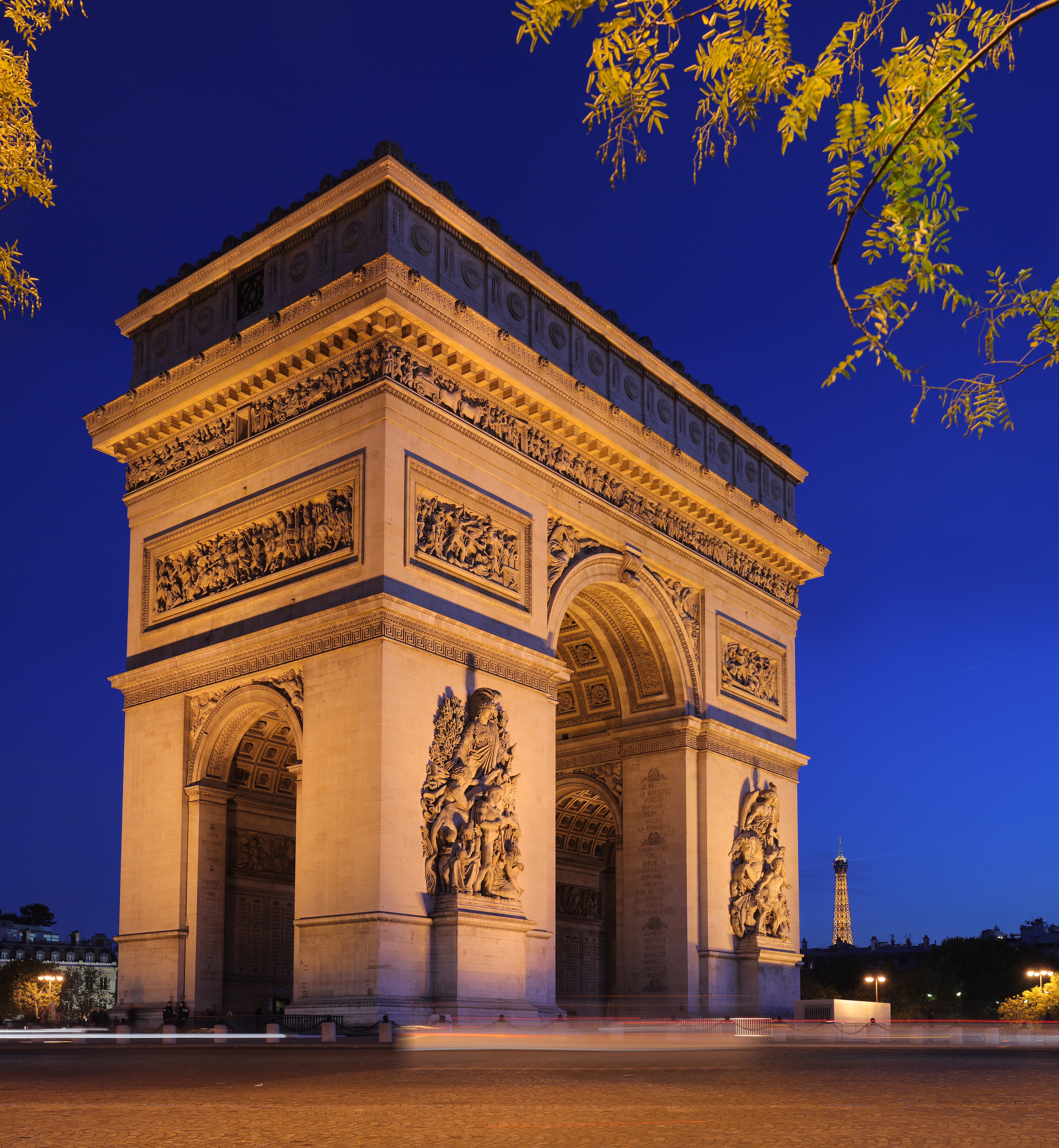
The Arc de Triomphe is a triumphal arch commissioned by Napoleon I in 1806 to commemorate French military victories. Architect Jean-François Chalgrin designed it after a dispute ended another architect’s collaboration. After the Battle of Austerlitz, Napoleon told French soldiers they would return home only beneath triumphal arches. His decree of 18 February 1806 ordered the monument, and Interior Minister Champagny persuaded him to place it at the Étoile rather than near the Bastille.
The foundation stone was laid on 15 August 1806, and the foundations took two years to build. By then, the structure had reached the vaults, but Napoleonic defeats interrupted construction and the Restoration brought abandonment. Chalgrin died in 1811 before the work was finished. Louis XVIII resumed construction in 1823, changing its purpose to commemorate the victorious expedition to Spain.
In 1830, Louis-Philippe restored Napoleon’s original purpose and broadened the tribute to armies that fought from 1792 to 1815. Guillaume-Abel Blouet completed the work between 1832 and 1836, and the arch was inaugurated on 29 July. A planned military review was cancelled after an attempt on the king’s life. The arch was unveiled quietly early that morning, with Adolphe Thiers and Antoine d’Argout present.
The design draws on Roman triumphal arches, including the Arch of Janus and the Arch of Titus. Four massive piers frame large and small arches, with sculpture, relief panels and a frieze arranged across three levels. Four principal reliefs rise eighteen metres on the piers. François Rude carved The Departure of the Volunteers of 1792, commonly called La Marseillaise, while other panels depict The Triumph of 1810, The Resistance of 1814 and The Peace of 1815.
Six smaller reliefs show episodes from the Revolution and Empire. Thirty shields on the attic bear battle names, while the inner faces of the piers carry engraved lists of battles and notable figures. The main frieze depicts the Departure of the Armies and the Return of the Armies. Allegorical Victories and figures representing infantry, cavalry, artillery and the navy decorate the archways, whose undersides are patterned with coffers.
A monumental sculpture was intended for the summit, but its first occupant did not remain. Alexandre Falguière’s plaster-and-timber group, The Triumph of the Revolution, was installed in 1882 and removed in 1886 as it deteriorated. The arch was designated a historic monument on 6 February 1896. On 7 August 1919, military aviator Charles Godefroy flew a Nieuport 17 beneath it.
The Tomb of the Unknown Soldier was installed beneath the arch on 11 November 1920, and the soldier’s remains were interred there in January 1921. An eternal flame was first lit on 11 November 1923 and is rekindled each evening. At the end of the 1980s, visible cracks and falling stone prompted investigation and foundation strengthening. Investigators traced the main damage to differential settlement, after water washed lime mortar from the foundations.
Architect Michel Marot led the restoration, while Solétanche carried out the work. Crews injected grout into voids, treated upper cracks, installed internal ties and waterproofed the arch. Restoration beginning in December 2003 addressed the terrace, attic balustrade, interior vault and lower rooms. Work continued until June 2005, covering safety, maintenance and planned interior improvements.
In February 2008, a permanent multimedia interpretation called Between Wars and Peace was inaugurated. Its seven stations across three levels address the monument’s history, symbolism, unrealized projects, lost features and sculpture. During a student demonstration on 11 November 1940, one of the first public acts of resistance to the occupation in France, the Nazis harshly repressed demonstrators. On 26 August 1944, Charles de Gaulle descended the Champs-Élysées after the Liberation of Paris, preceded by four tanks of the 2nd Armored Division.
During the Gilets jaunes demonstration on 1 December 2018, protesters entered the arch and caused significant damage. Eight demonstrators were convicted in 2021, and the minister of culture estimated the overall restoration cost at 1.2 million euros. From 18 September to 3 October 2021, Christo and Jeanne-Claude’s posthumous artwork wrapped the arch in fabric. The project used 25,000 square metres of fabric and three kilometres of red rope, following work Christo had begun in 1961.
The arch measures 49.54 metres high, 44.82 metres wide and 22.21 metres deep. One hundred markers encircle it, symbolizing the Hundred Days, and twelve avenues radiate from the square at its centre. Its sculptural program recalls the armies and battles of the Revolution and Empire. The Tomb of the Unknown Soldier represents all soldiers who died for France, and the flame honors those killed in combat. The arch has also formed a setting for national ceremonies and public gatherings. Napoleon’s ashes passed beneath it in 1840, and the Champs-Élysées held celebrations after France’s 1998 World Cup victory.
Listen to this audio guide in the app
The website shows the text and photos. The audio guide, map and nearby places are in the free Hotspot app.
Download free on Google Play