
Sainte-Chapelle
Paris, France
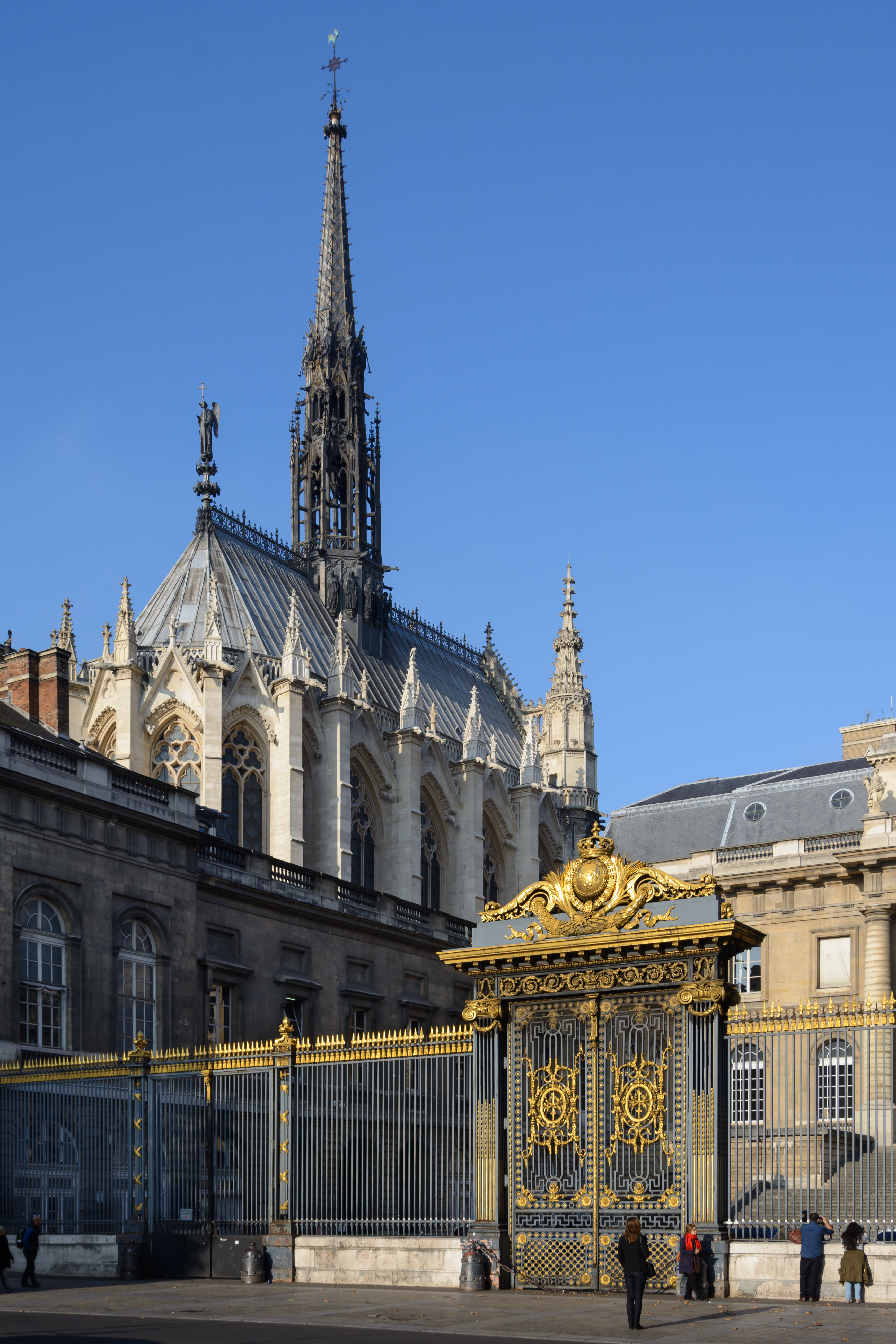
The Sainte-Chapelle is a royal chapel in Paris, commissioned by Louis IX to house relics associated with the Passion. Its construction began between autumn 1241 and May 1244, within the Palace of the City. In 1238, Baudouin II pledged the Crown of Thorns to the Venetian merchant Nicolo Quirino. Louis IX bought the relic for 135,000 livres tournois, and it arrived in Paris in August 1239. The king acquired a large fragment of the True Cross and other Passion relics in 1241 and 1242.
Louis IX commissioned the chapel to preserve and venerate these relics, replacing an earlier chapel dedicated to Saint Nicholas. Its position inside the palace joined royal worship with judicial practice, where lords and vassals swore oaths on relics. The chapel also served the royal court, palace staff and a college of clergy.
The high chapel was consecrated to the Holy Cross on 26 April 1248, while the lower chapel was dedicated to the Virgin. In January 1246, Louis IX had established a college of clergy, whose members guarded the relics, cared for the stained glass and lights, and celebrated services. The two chapels served different groups, with the high chapel reserved for court and clergy.
The building has two chapels, one above the other, each arranged as a single vessel with four rectangular bays and a seven-sided apse. The high chapel’s walls are almost entirely windows, with iron bars and concealed metal ties helping resist the vaults’ outward thrust. Its stained glass tells biblical history through 1,113 scenes, combining red and blue tones with painted architectural decoration.
The relics shaped services throughout the year. On the night before Good Friday, the True Cross was displayed to the sick, and accounts describe episodes of mass hysteria during the ceremony. Daily masses took place in both chapels, alongside ceremonies connected with the Passion relics and, after Louis IX’s canonization in 1297, his cult.
Royal ceremonies continued in the chapel after the Palace of the City ceased to be a royal residence. Marie de Brabant was crowned there in 1275, and Henry VII married Marguerite of Brabant there in 1292. Isabeau of Bavaria was crowned in 1389, among the later royal ceremonies held before weddings and coronations ended in the late fourteenth century.
In 1306, the head relic of Saint Louis was brought to the chapel. The western rose window was made between 1485 and 1495, adding a later Flamboyant Gothic feature to the building. Louis XII began an exterior stair along the south wall, while François I added Renaissance furnishings, including a carved wooden surround for the great reliquary and a new rood screen.
After royal weddings and coronations ended, the chapel was used for funeral services. Louis XVI prohibited those services following a dispute in 1774. A royal council decision in 1787 began administrative and financial rationalization of the kingdom’s Sainte-Chapelles, before worship at this chapel ceased around 1790.
During the Revolution, the chapel lost its parish status in 1791 and its relic treasury. The great reliquary was melted down that year, and other reliquaries were melted in 1791 and 1793. The building’s furnishings disappeared, stained-glass panels were broken or displaced, sculpture was mutilated, and its spire was demolished.
The chapel became state property and was used by the Club de la Sainte-Chapelle before serving as an archive depot for the Palace of Justice from 1797. Expansion of the palace threatened the building, prompting a campaign to save it. Public pressure brought a decision to preserve the chapel in 1836, and restoration began the following year.
Félix Duban initially directed the restoration, with Jean-Baptiste-Antoine Lassus as first inspector. Duban resigned in 1849, and Lassus took charge, but his death in 1857 left Émile Bœswillwald to complete the work in 1863. The restoration replaced missing parts rather than rebuilding the chapel systematically, and included repairs to masonry and sculpture, painted decoration, and the reliquary tribune.
Lassus designed a new wooden spire in a fifteenth-century Flamboyant Gothic style. It was erected from 1853 to 1855 as a new design, not an exact reconstruction of an earlier spire. Disputes during restoration concerned whether to rebuild systematically, how much polychromy to restore, and whether to isolate the chapel from the surrounding palace buildings. The chapel was listed as a historic monument in 1862, before restoration was complete.
The chapel’s high windows form a narrative cycle that links biblical history, prophetic themes surrounding Christ, and Louis IX’s receipt of the Passion relics. The arrangement connected the royal collection with the crown and the administration of justice. The relics were understood as a safeguard of the French kingdom and as part of the Capetian monarchy’s claim to imperial traditions.
The Sainte-Chapelle’s architecture and stained glass influenced later chapels and churches, including the chapel of the Institution des Chartreux in Lyon. Its musical tradition included Marc-Antoine Charpentier, music master from 1698 to 1704, and Nicolas Bernier, appointed in 1704. The chapel and the Conciergerie remain parts of the former Palace of the City.
Restoration campaigns began again in 2008, including work on masonry and stained-glass windows on the east, north and west elevations. The chapel became part of the UNESCO World Heritage property Paris, Banks of the Seine, in 1991. It received more than 1,375,000 visitors in 2019.
Listen to this audio guide in the app
The website shows the text and photos. The audio guide, map and nearby places are in the free Hotspot app.
Download free on Google Play