
Bohus Fortress
Kungalv, Sweden
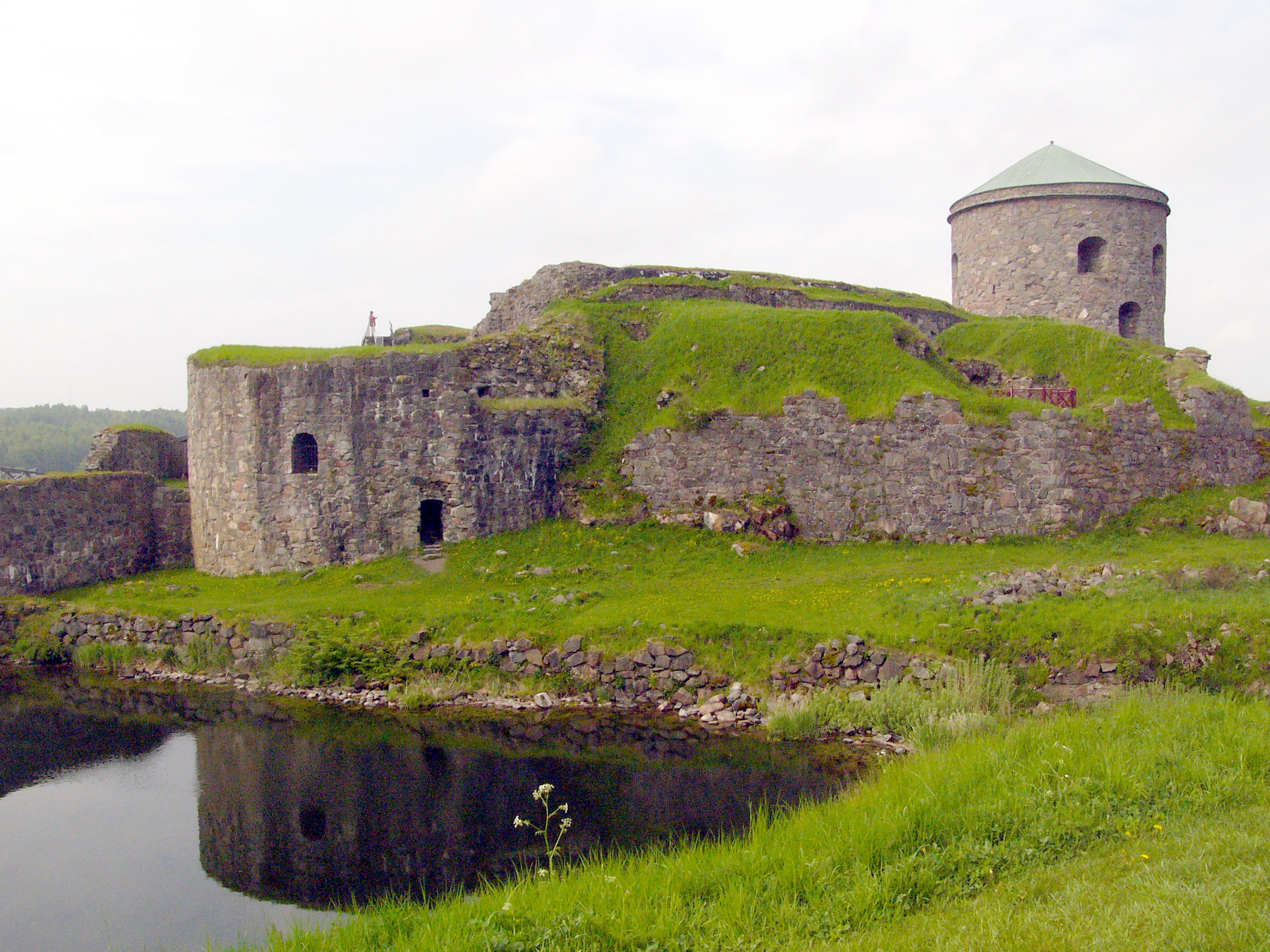
Bohus Fortress is a ruined fortress begun in 1308 to defend Norway’s southern border. Built on Bagaholmen, it also controlled river routes along the Göta älv and Nordre älv. The first stronghold was wooden, and the site soon became a Norwegian administrative center. It later served as a royal residence, where Magnus Eriksson was declared of age in 1331. Four years later, Magnus married Blanche of Namur at the fortress.
In 1344, Magnus’s son Håkan was acclaimed king of Norway there. In 1389, Albert of Mecklenburg arrived as a prisoner on Queen Margaret’s orders. During the fifteenth and sixteenth centuries, the fortress collected tolls from traffic on the Göta älv.
The toll dispute between Norway and Sweden reached diplomatic negotiations. In 1473, Sten Sture decided to move Lödöse nearer the river mouth, partly because of the toll at Bohus. The fortress continued to serve regional administration and commerce.
A Swedish assault in 1566 reached Röde Torn, the fortress’s core tower. Defenders blew up the tower, in an explosion known as the Bohus Blast. The account estimates that about 250 Swedish soldiers died.
After the Nordic Seven Years’ War, work began to turn the damaged medieval castle into a Renaissance complex. Hans van Paeschen and Hans van Steenwinckel the Elder led the rebuilding from 1584 to 1604. Stone defenses, outer walls and bastions developed around the earlier stronghold.
Prisoners excavated the castle well in the courtyard between 1616 and 1630. Cut into rock, it reaches 22 metres deep, with an oval platform about 9 metres wide and 13 metres long. Prisoners also performed heavy labor on major fortification projects.
In August 1645, Swedish forces set Ny-Kungälv on fire with heated cannonballs. Troops from the fortress later plundered and burned some buildings in the town. From 1648 to 1651, military engineer Isaac van Geelkerck’s plans reshaped the southern defenses.
Workers removed the south ring wall and towers, then built Mors Mössa and Krabbetornet. The entrance gained an outwork called Svingeln and a bastion called Larmposten. In 1658, the Danish garrison departed, and Iver Krabbe handed the keys to Swedish general Erik Stenbock, who passed them to the new commandant.
In 1678, Danish-Norwegian forces besieged Bohus for nearly two months. They fired tens of thousands of cannonballs and other projectiles, nearly reducing the fortress to rubble. Swedish-Finnish defenders suffered heavy casualties before relief arrived.
After the siege, the castle was rebuilt without its former decorative splendor and with a stronger military character. It served as the governor of Bohuslän’s residence until 1700, though its military importance declined after it ceased to be a border fortress. Dark prison cells occupied Fars Hatt and Sven Halls Tower.
In Fars Hatt, a coarse iron-grille floor lay six metres below the first floor of a prison cell. A cell found in Sven Halls Tower during restoration in the 1930s had been in the basement of the former Musetornet. The fortress also held prisoners for forced labor.
The permanent garrison left in 1786, and a royal order to demolish the fortress followed in 1789. Residents were permitted to take building stone, while demolition was halted and restarted. Further destruction finally stopped in 1838.
Excavation and conservation work took place from 1898 to 1904 under Colonel Claes Grill. The state Building Board took over the ruin in 1925, and a major renovation began in 1934, including reconstruction of the main gate. Bohus Fortress became a state-listed building monument in 1935, and restoration continues.
A visitor center opened in a nearby villa on the fortress island in 2014. In 2011, the municipality and the National Property Board agreed to invest three million kronor each per year for ten years in museum development and the island’s visitor destination. The account reported approximately 50,000 annual visitors in 2011. Bohus Fortress endured at least fourteen sieges and was never captured in battle. Its name became the name of the province of Bohuslän, and the fortress played a role in relations among Norway, Denmark-Norway and Sweden, in both peaceful and military affairs.
Listen to this audio guide in the app
The website shows the text and photos. The audio guide, map and nearby places are in the free Hotspot app.
Download free on Google Play