
Vatican City
Rome, Holy See (the)
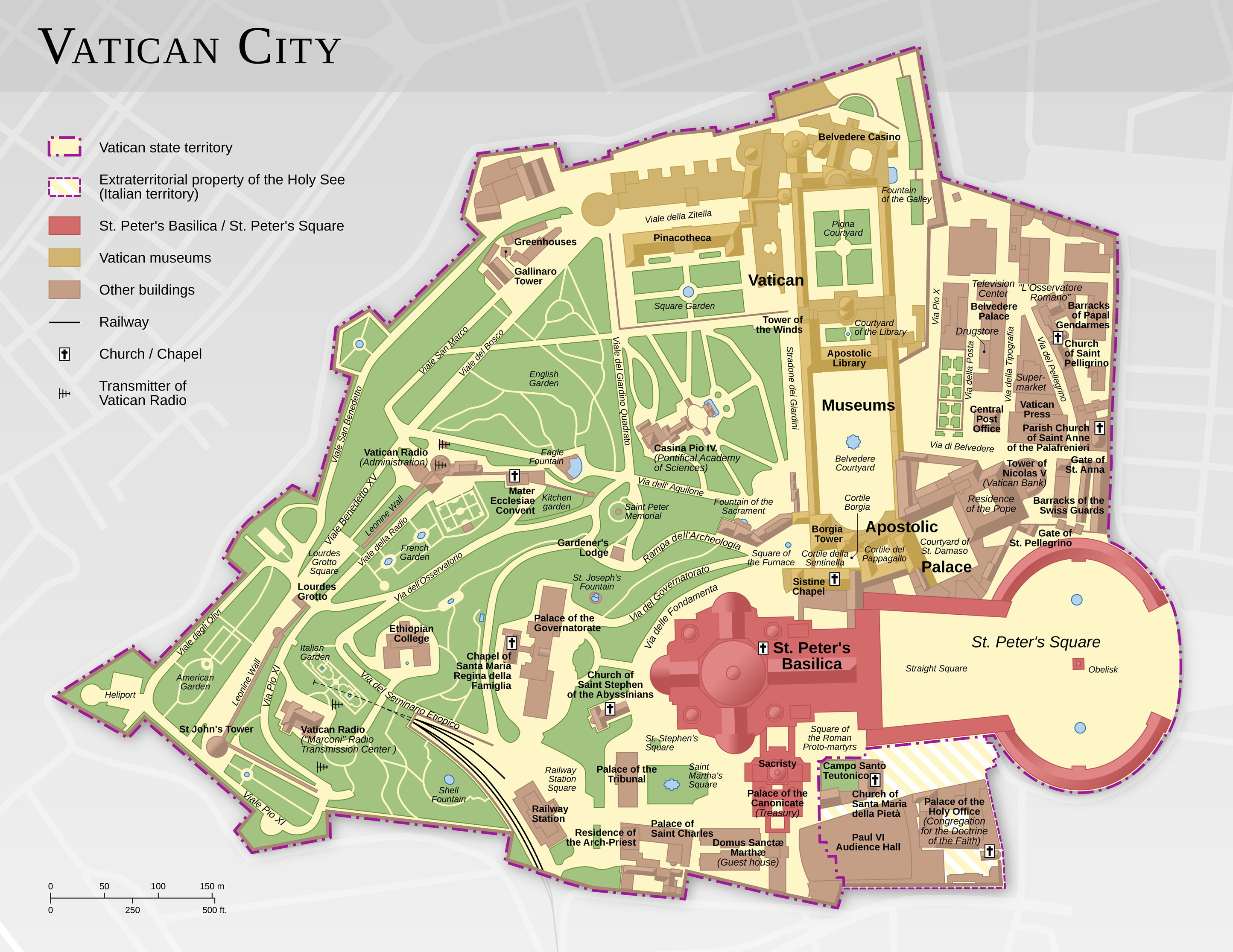
Vatican City is a sovereign city-state established in 1929 as the territorial base of the Holy See. Its 0.44 square kilometres lie within Rome, enclosed almost entirely by medieval and Renaissance walls. The story began with the loss of papal territory. On 20 September 1870, Italian troops entered Rome through a breach at Porta Pia. Nine days later, a royal decree proclaimed Rome Italy’s capital and suppressed papal temporal power.
Pope Pius IX rejected the occupation and the Law of Guarantees, which Italy had imposed unilaterally. He considered himself a prisoner in the Vatican and never left the territory. The dispute between Italy and the Catholic Church became known as the Roman Question and lasted 59 years.
Negotiations over a possible papal state took years, as the Holy See and Italy disputed its size and scope. On 11 February 1929, they signed the Lateran Pacts, recognizing each other’s independence and sovereignty. The treaty established Vatican City within the Leonine Walls and included St. Peter’s Square.
The Pacts also included a concordat and a financial convention. Vatican City was established on 7 June 1929, under Pope Pius XI. The new state gave the Holy See a territorial base for its activities and diplomatic relations, while sovereignty over the state belonged to the Holy See.
At its centre, St. Peter’s Square faces St. Peter’s Basilica, whose dome dominates the city-state. The walls enclose almost all the territory, but not the square. Within them are the Apostolic Palace, the Governorate Palace, the Vatican Museums and the Vatican Gardens.
The Apostolic Palace serves as the Pope’s residence and contains papal offices, museums and the Vatican Apostolic Library. Its complex has more than a thousand rooms. The library holds about 1.6 million printed books and around 500,000 other items, including manuscripts, incunabula, coins, medals and artworks.
In 1948, the Constitution of the Italian Republic recognized the Lateran Pacts in Article 7. Vatican City is governed as an elective absolute monarchy. The Pope holds legislative, executive and judicial powers as head of state.
The state also developed practical systems of its own. It operates a postal service and issues stamps valid for mail sent from Vatican City, as well as euro coins under its customs and monetary union with Italy. A railway line connects it with Italy, but carries no regular passenger or freight traffic and is reserved for exceptional events.
A 1.2-kilometre railway line is not the only transport facility within the territory. A heliport in the Vatican Gardens serves papal short journeys and visiting heads of state. The state also provides emergency medical care for people needing urgent help in its territory and adjacent extraterritorial zone, especially during large events.
In 2008, Vatican City began expanding its solar-energy systems, including photovoltaic installations at several sites. In 2019, it prohibited single-use plastics. On 12 June 2023, SpeiSat, the Vatican’s first satellite and orbital mission, was launched.
As of 26 June 2023, the state had 764 inhabitants, including 246 citizens. The total number of citizens, including those living elsewhere, was 618. These figures describe different groups: residents, resident citizens and all citizens.
The artistic buildings took shape across different periods and through the work of several artists and architects. St. Peter’s Basilica is associated with Bramante, Pinturicchio, Michelangelo and Bernini. Michelangelo painted the Sistine Chapel’s frescoes, while Raphael painted the frescoes in the Raphael Rooms and loggias.
St. Peter’s Square is framed by Bernini’s colonnade, and the basilica’s dome overlooks the square. The Vatican Museums include the Gregorian Egyptian and Etruscan Museums, the Pio-Clementino Museum, the Chiaramonti Museum and the Vatican Pinacoteca. The Apostolic Palace complex brings papal offices, museums and the library together within the walls. The entire territory of Vatican City is inscribed on the UNESCO World Heritage List. Holy See properties outside the city-state, in central Rome, are also recognized as part of the heritage listing.
Listen to this audio guide in the app
The website shows the text and photos. The audio guide, map and nearby places are in the free Hotspot app.
Download free on Google Play