
Florence Cathedral
Florence, Italy
Florence Cathedral is the principal church of Florence, built to replace the smaller Santa Reparata. The city government chose a larger church in 1294, after the earlier cathedral became inadequate for the expanding city. The site had hosted places of worship since Roman times, and Santa Reparata stood beneath the present church. The Florentine Signoria ordered the new cathedral, and Cardinal Pietro Valeriano Duraguerra laid its first stone on 8 September 1296.
Arnolfo di Cambio directed the initial work, but construction slowed after his death in 1302. It then stopped for about thirty years, leaving the replacement church unfinished while Santa Reparata continued in use. In 1334, the Arte della Lana appointed Giotto to direct the works. He concentrated on the campanile, assisted by Andrea Pisano, but work was interrupted again after Giotto died in 1337 and Pisano in 1348.
Construction resumed under Francesco Talenti in 1349, and the design expanded. Giovanni di Lapo Ghini oversaw much of the nave structure, whose central and side vaults were completed in 1378 and 1380. The eastern tribunes and the dome’s supporting drum were completed by 1421, leaving a vast opening above the church. The building joined a three-aisled body to a three-part eastern end, with the dome still to be solved.
A decree in 1412 changed the cathedral’s name from Santa Reparata to Santa Maria del Fiore. Six years later, a competition sought a way to cover the central opening, bringing Filippo Brunelleschi and Lorenzo Ghiberti into contention, though no official winner was declared. Brunelleschi’s answer was a self-supporting dome built without traditional centering. Its two shells, eight marble ribs and herringbone brickwork supported construction as the courses rose.
The dome’s structural work was complete when Pope Eugene IV dedicated the cathedral on 25 March 1436. Its lantern followed later, completed by Michelozzo in 1461, with a gilded sphere placed above it in 1468. On 26 April 1478, an attack during Mass brought the Pazzi conspiracy into the cathedral. Giuliano de’ Medici was killed, while his brother Lorenzo was wounded and escaped into the sacristy.
Girolamo Savonarola began preaching in the cathedral in 1491, condemning moral decadence, renewed paganism and ostentatious wealth. The sphere atop the lantern fell in 1492, then fell again during a storm on the night of 17 July 1600. A larger replacement sphere was put back in place in 1602. The cathedral’s astronomical instrument also served solar observations, including investigations that contributed to arguments for calendar reform.
The façade remained unfinished for centuries. Its surviving decorative section was demolished in 1587, and a replacement design proposed by Bernardo Buontalenti was never built. Work on the present façade began in 1871, following a design by Emilio de Fabris, and ended in 1887 under Luigi del Moro. The polychrome composition uses marble and includes three bronze doors with scenes from the life of the Virgin.
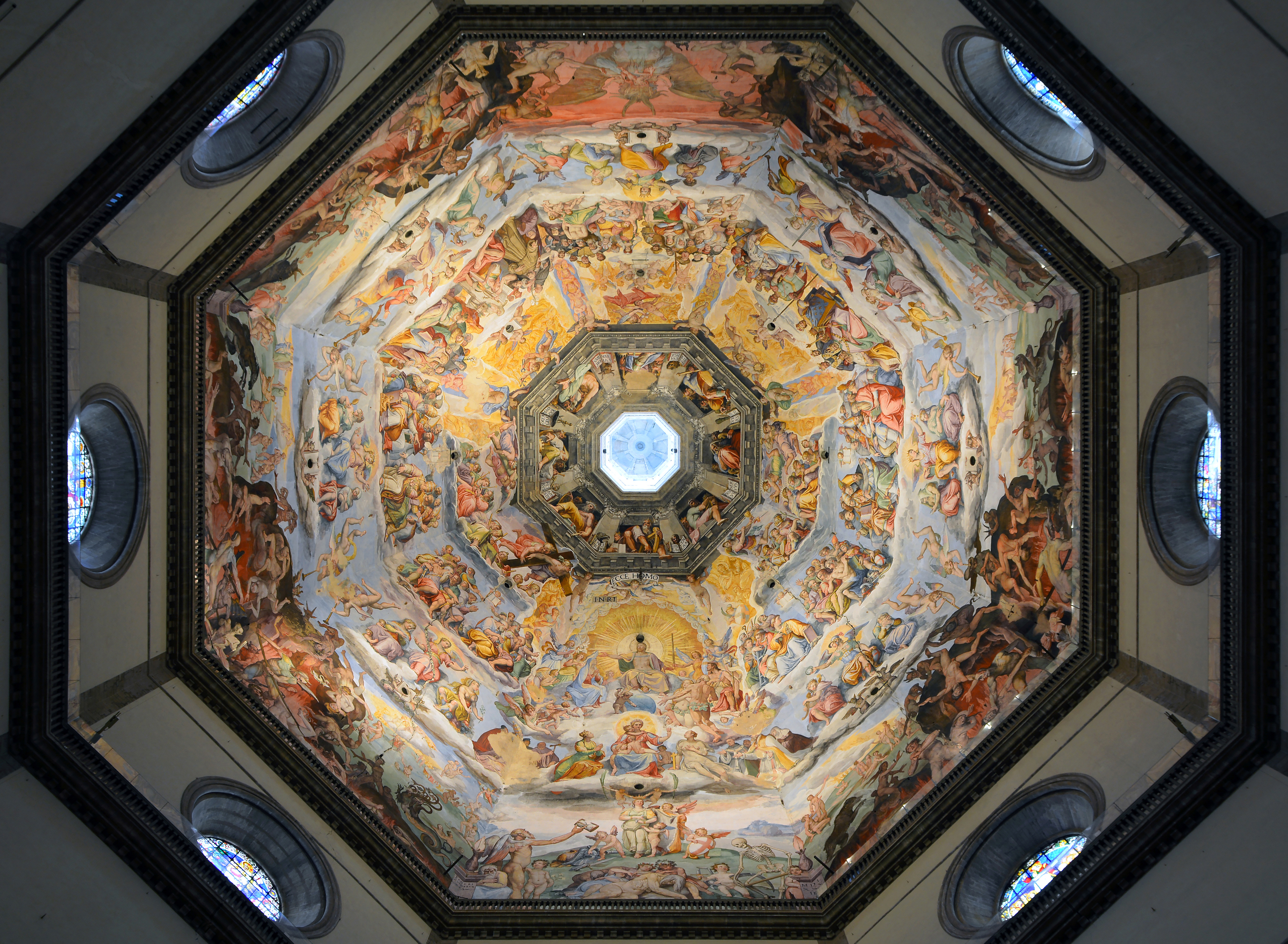
Inside, the dome carries a Last Judgment fresco cycle painted from 1572 to 1579. Giorgio Vasari began the work, and Federico Zuccari completed it with collaborators, covering 3,600 square metres. The church’s interior was substantially altered during the Counter-Reformation and again in 1688, when choir lofts by Luca della Robbia and Donatello were dismantled. A restoration in 1842 removed many traces of the earlier interior.
Excavations beneath the cathedral from 1965 to 1974 revealed Roman dwellings, an early Christian pavement and the ruins of Santa Reparata. In 2022, restoration of a Madonna and Child relief at the Porta di Balla revealed extensive surviving traces of polychromy. The cathedral’s nave and eastern tribunes form a structure 153 metres long and 38 metres wide. Its dome’s inner height is about 90 metres, and its frescoed surface spans 3,600 square metres.
The interior includes 44 figured stained-glass windows among 55 in total, most made between 1434 and 1455. Artists whose designs contributed to the windows include Donatello, Lorenzo Ghiberti, Paolo Uccello and Andrea del Castagno. The cathedral hosted public readings of Dante’s Divine Comedy and the Council of Florence in 1438 and 1439. That council brought representatives of the Latin and Byzantine churches together. When completed in the fifteenth century, Florence Cathedral was the world’s largest church, and its masonry dome remains the largest ever built. It serves as the seat of the Archdiocese of Florence, holds minor basilica status and is an Italian national monument.
Listen to this audio guide in the app
The website shows the text and photos. The audio guide, map and nearby places are in the free Hotspot app.
Download free on Google Play