
Palazzo Medici Riccardi
Florence, Italy
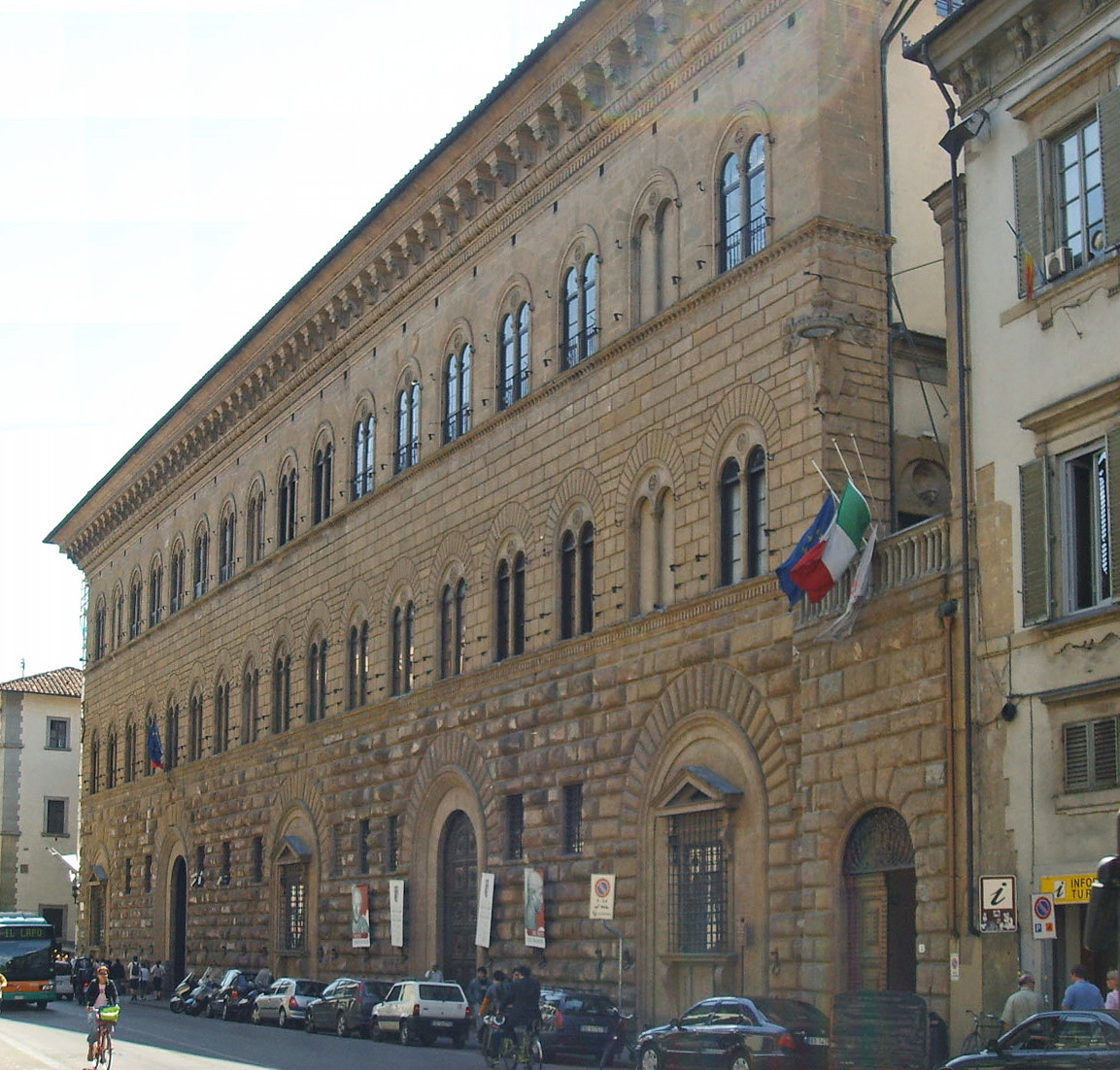
Palazzo Medici Riccardi is a Renaissance palace commissioned by Cosimo the Elder and designed by Michelozzo. Construction began in 1444 and continued until 1452 or 1460. Cosimo first sought a design from Filippo Brunelleschi, but rejected the proposal as too magnificent and likely to provoke envy. Vasari later described it as excessively sumptuous, though no other evidence confirms that Brunelleschi’s project existed. Cosimo instead chose Michelozzo, whose nearly cubic palace formed a restrained block around a square courtyard.
The façade’s three levels are separated by cornices, with rough stonework becoming smoother toward the upper floors. Regular paired windows, Medici emblems and a stone bench along the east and south sides complete the exterior. In 1459, a private chapel was created for Piero the Gouty.
Benozzo Gozzoli covered the Chapel of the Magi with frescoes showing the Procession of the Magi. Medici family members and political figures appear among the procession, while the religious subject presents the family’s political achievements. The altar now holds a late fifteenth-century copy of Filippo Lippi’s Nativity; the original is in Berlin.
Under Lorenzo the Magnificent, the palace held Medici art collections and hosted young artists, including Michelangelo, alongside humanists such as Pico della Mirandola and Agnolo Poliziano. Lorenzo’s wife, Clarice Orsini, acquired the nearby Orto di San Marco, where classical sculpture supported an early art academy directed by Bertoldo. After Lorenzo died in 1492, the palace’s fortunes changed. In 1494, an uprising followed Piero de’ Medici’s conduct during the passage of Charles the Eighth’s French army. The palace was sacked, and Medici treasures were confiscated in the name of the Florentine Republic.
The upheaval also scattered works of art. Donatello’s Judith and Holofernes moved from the palace garden to Piazza della Signoria, while his David was transferred to Palazzo Vecchio. Cardinal Giovanni and Cardinal Giulio de’ Medici returned to Florence in 1497 with Spanish military assistance.
In 1517, large ground-floor windows attributed to Michelangelo were installed, replacing the original street-side loggia. Their kneeling shape gave them the name inginocchiate. Baccio Bandinelli made the courtyard’s Orpheus statue in 1519.
A second sack followed the Medici expulsion of 1527, after the Sack of Rome and the political crisis for Pope Clement the Seventh. The Medici returned after Florence’s recovery in 1530. In 1540, Cosimo the First moved to Palazzo Vecchio, and the Via Larga palace lost its former role as the family’s principal representational residence.
After passing among Medici family members, the palace returned to Grand Duke Ferdinando the Second. Gabriello Riccardi bought it from him in 1659 for 40,000 scudi. The Riccardi doubled the building’s size, extending the façade while retaining the old exterior’s fifteenth-century character.
The Riccardi added Baroque interiors, including a grand staircase designed by Giovan Battista Foggini and a gallery completed in 1685. Its gilded stucco and painted mirrors surround Luca Giordano’s illusionistic ceiling fresco, depicting the Apotheosis of the Medici family. In 1669, Jacopo Melani’s Il ritorno di Ulisse received its first performance in the palace; Enea in Italia followed in 1670.
Financial difficulties led Riccardi descendants to sell the palace to the grand-ducal government in 1810. It became an administrative building and housed the Ministry of the Interior during Florence’s period as capital in 1865. The Province of Florence acquired it in 1874 and remains an owner alongside the Prefecture.
Major restoration work from 1911 to 1929 removed alterations made during decades of administrative use and recovered parts of the original structure. The work retained substantial seventeenth- and eighteenth-century additions, removed a steel canopy in the garden, recreated its seventeenth-century layout and uncovered original columns. A Medici iconography museum opened in ground-floor rooms in 1939, displaying family memorabilia and relics. On 11 August 1944, the Tuscan National Liberation Committee established itself in the palace and proclaimed the general uprising of Tuscany. The Provincial Deputation held its first administrative meeting there the next day.
The 1966 flood seriously damaged the Medici iconography museum installation. After restoration, the old museum was not re-established, and ground-floor rooms began hosting temporary exhibitions in 1972. Measurement work in 1988 and 1989 also rediscovered a hidden seventeenth-century room in the mezzanine.
The Chapel of the Magi opened to the public in 1992 under visitor-number restrictions for conservation. Since 2000, the palace’s museum route and exhibition venue have operated with a single admission ticket. A 2018 architectural project gave renewed use to the former Medici stable and Riccardi cellars.
The courtyard combines smooth columns and composite capitals with paired windows above and an upper loggia of Ionic columns. Its classical motifs, Medici heraldry and mythological imagery follow a perspective that is not perfectly symmetrical. The Orpheus statue was moved from the courtyard’s center in 1916.
Lorenzo’s collections included works by Donatello, Paolo Uccello, Botticelli, Verrocchio, Pollaiolo and Domenico Ghirlandaio. Michelangelo spent part of his adolescence in the palace, while the Orto di San Marco’s academy gave young artists access to classical models and techniques. The palace’s present functions combine public administration, official residence, libraries, museum displays and exhibitions. The Riccardiana Library occupies the newer wing and is managed by the state; the separate Moreniana Library was established in 1839 and is managed by the Province.
Listen to this audio guide in the app
The website shows the text and photos. The audio guide, map and nearby places are in the free Hotspot app.
Download free on Google Play