
Alexander Fleming
Athens, Greece
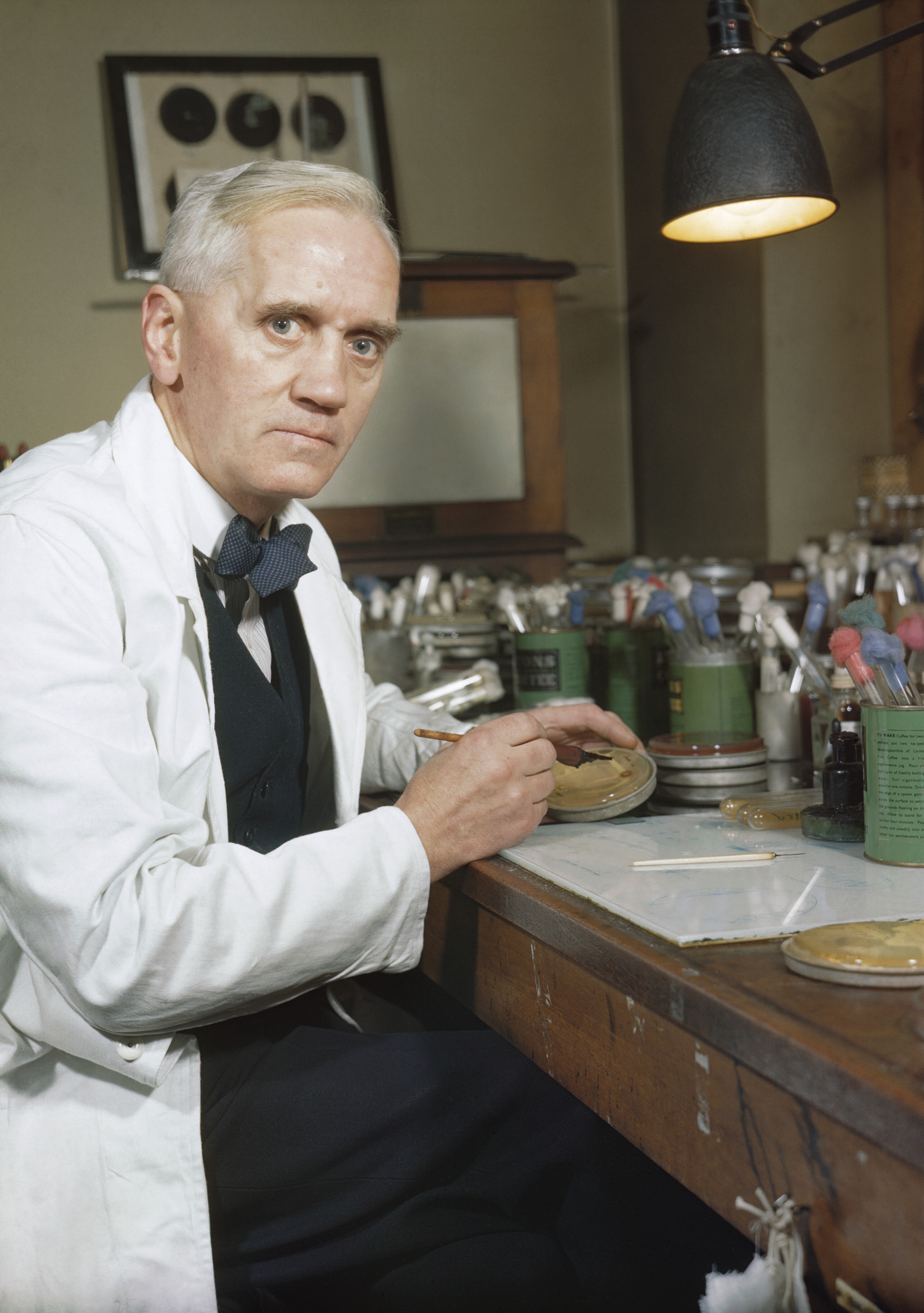
Alexander Fleming was a Scottish biologist and pharmacologist, born at Lochfield farm near Darvel in 1881. He discovered penicillin in 1928 while working at St Mary’s Hospital in London. Fleming spent two years at Kilmarnock Academy, then worked for four years in a shipping office. After inheriting money from an uncle, he enrolled at St Mary’s in 1901. He qualified in medicine with distinction in 1906 and received a degree with a Gold Medal in 1908.
Encouraged by the head of his rifle club to pursue research, Fleming became an assistant bacteriologist to Sir Almroth Wright. He remained at St Mary’s as a curator until 1914. During the First World War, he served as a captain in the Royal Army Medical Corps, working in field hospitals on the Western Front in France.
Fleming married nurse Sarah Marion McElroy in 1915 and returned to St Mary’s Medical School in 1918. In 1922, he discovered lysozyme, an enzyme. He became Professor of Bacteriology at St Mary’s in 1928, the year his work on penicillin began.
On 28 September 1928, Fleming returned from holiday and noticed a bacteria-free zone around mold contaminating staphylococcal cultures. He identified the mold as belonging to the genus Penicillium and named its antibacterial substance penicillin. He published the discovery in 1929, but it attracted little attention.
Fleming continued researching and tried to interest a chemist in producing usable quantities. The mold was difficult to culture, and the active substance was difficult to isolate. He doubted its practical importance, believing it might not remain in the human body long enough to work.
In 1940, an Oxford group published initial results on penicillin, and Fleming contacted Howard Florey and visited the team. Ernst Chain, working on ways to isolate and concentrate penicillin, reportedly exclaimed that he had thought Fleming was dead. Chain developed an isolation method, while the Oxford group pursued purification and mass production.
After the bombing of Pearl Harbor, mass production began. By the Normandy landings, enough penicillin had been prepared for the needs of all Allied casualties. Fleming was knighted in 1944 and shared the 1945 Nobel Prize in Physiology or Medicine with Florey and Chain.
Fleming’s first wife, Sarah, died in 1949. He married Greek physician and bacteriologist Amalia Koutsouri-Vourekas in 1953. He died suddenly of a heart attack at his London home in 1955, and his ashes were interred at St Paul’s Cathedral one week later.
Penicillin’s discovery marked the beginning of the antibiotic era. In lectures around the world, Fleming warned that inadequate doses or stopping treatment too soon could encourage bacteria to develop resistance. He praised Florey and Chain for turning a laboratory curiosity into a practically useful medicine.
The laboratory at St Mary’s where Fleming discovered penicillin now houses the Fleming Museum. National Museums Scotland acquired his Nobel medal in 1989. A central street in Kato Achaia and a biomedical research center in Vari were named in his honor.
Stories linking Fleming to Winston Churchill are inaccurate. One claims Lord Randolph Churchill paid for Fleming’s education after Fleming’s father saved the young Winston; Fleming called it “a wondrous fable” in a 1945 letter. Another claims Fleming saved Churchill with penicillin during the Second World War. In 1943, Churchill was treated in Carthage with sulfapyridine, a sulfonamide given by his physician, Lord Moran.
Listen to this audio guide in the app
The website shows the text and photos. The audio guide, map and nearby places are in the free Hotspot app.
Download free on Google Play