
Arrephorion
Athens, Greece
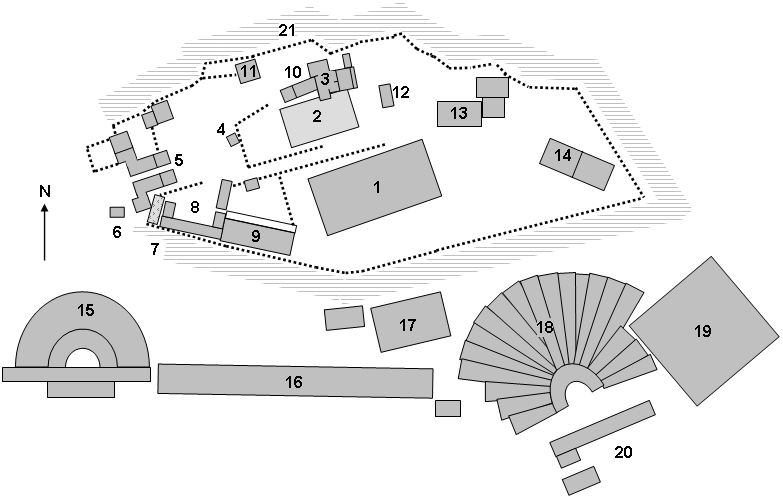
The Arrephorion was a square building on the Acropolis of Athens, dated to 470 BC. It housed two girls, the Arrephoroi, who served Athena in Panathenaic rites. Excavations distinguish three phases. The first probably dates to the time of Peisistratus; the second was built in great haste immediately after the Persian Wars. The final phase followed reshaping of the Acropolis’s northern side and was associated with construction of the Erechtheion. Its foundations stood 3 metres higher than those of the preceding building.
Each year, two girls aged 7 to 11 were chosen to weave Athena’s peplos, which covered the goddess’s wooden cult statue during the Panathenaia. They also carried sacred vessels during the Arrephoria. A staircase cut into the northern slope connected the building with the city, and the girls descended by it during that festival.
The building measured 12.5 metres on each side. Its western courtyard, called the Ball Court, was used by the Arrephoroi for play. Georg Kawerau and Panagiotis Kavvadias discovered the building in 1886; Wilhelm Dörpfeld first identified it in 1920.
Only foundations from the three phases survive. After excavation left them exposed to significant erosion, the Acropolis Monuments Conservation Service reburied them in 2006. The traces are no longer visible, though the building supported the Panathenaia and the Arrephoria, festivals associated with Athena.
Listen to this audio guide in the app
The website shows the text and photos. The audio guide, map and nearby places are in the free Hotspot app.
Download free on Google Play