
Arch of Hadrian (Athens)
Athens, Greece
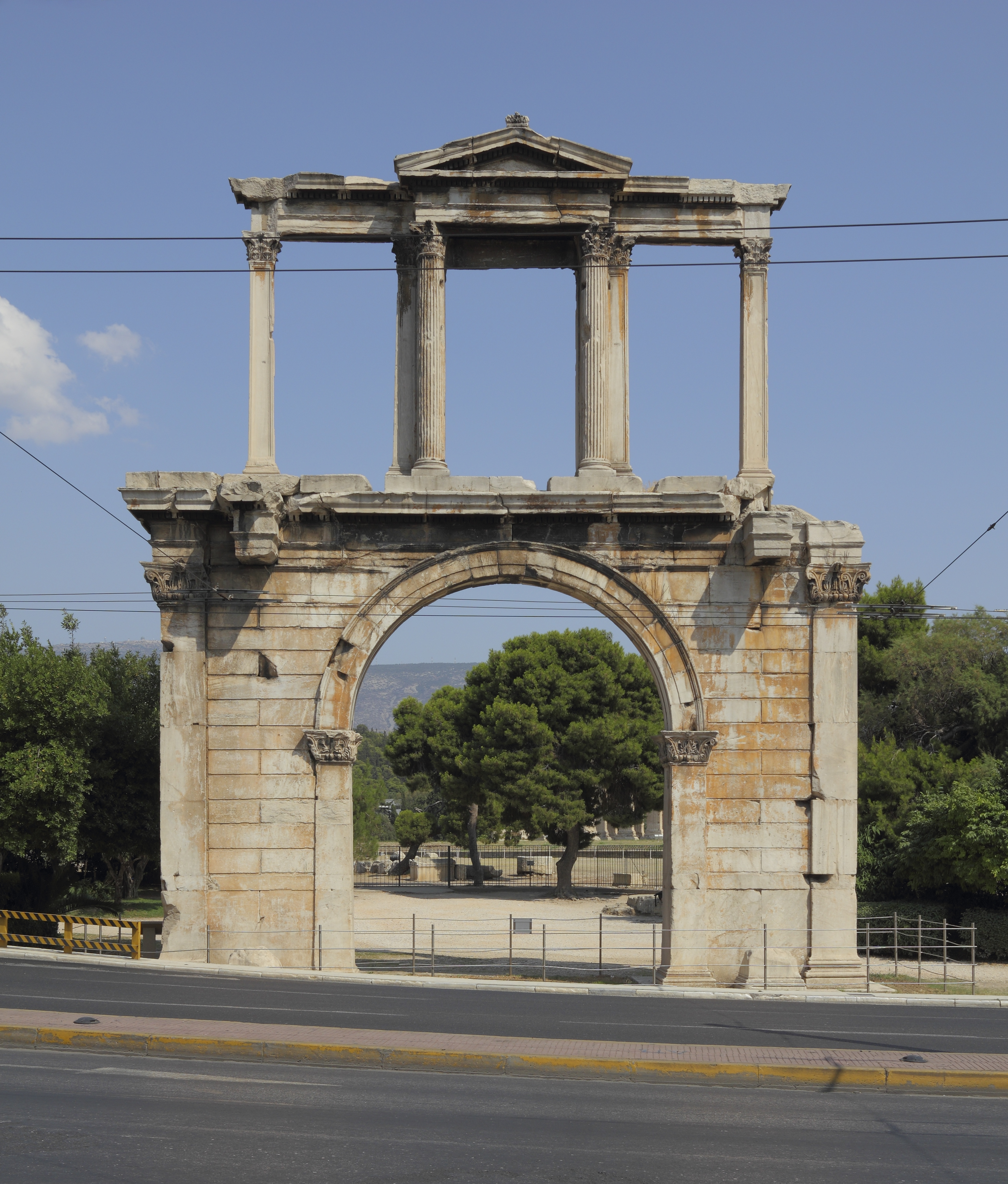
The Arch of Hadrian is a marble gate in Athens, thought to have been built around 131 or 132 CE. Its construction honored Emperor Hadrian in connection with the dedication of a nearby temple, though its commissioner is unknown. The gate spanned an ancient road from central Athens toward an eastern settlement that included the Temple of Olympian Zeus. Its lower level resembles a Roman arch, while the upper level takes its form from ancient Greek propylaea. Builders joined blocks of Pentelic marble with clamps, using neither cement nor marble mortar.
The design is symmetrical, with one arched passage below and three rectangular openings above. Corinthian piers support the lower passage, alongside additional columns and an Ionic entablature. The upper central opening was once closed by a thin marble slab; only its fixing slots remain.
In the mid-eighteenth century, James Stuart and Nicholas Revett made an architectural study of the gate. From 1751 to 1753, they recorded its structure while its base lay about one metre underground. The gate had never been protected from burial, yet it survived in good overall condition.
In 1778, the arch became part of the eastern section of Athens’s Ottoman city wall, the Haseki Wall. It was converted into a gate and became known as the Queen’s Gate or Kamaroporta. The wall’s addition changed the role of a structure first built over an ancient road.
Two inscriptions associate Athens with Theseus and Hadrian. One faces northwest toward the Acropolis and identifies Theseus’s earlier city; the other faces southeast toward the Temple of Olympian Zeus and identifies Hadrian’s city. Their meaning remains debated: they may divide the city into old and new parts, or describe Hadrian’s refoundation of Athens as a whole.
Excavations disproved the idea that the arch marked the boundary of an ancient city wall. A gate in the Themistoclean Wall was excavated about 140 metres east of it. The inscriptions are now generally interpreted as referring to the refoundation of the whole city, rather than a division between two cities.
The gate is 18 metres high, 13.5 metres long, and 2.3 metres wide. Its lower storey has a single passage, while the upper storey’s three openings and triangular pediment differ from the solid upper levels common on Roman triumphal arches. Statues possibly depicting Theseus or Hadrian have been proposed, but their presence and placement remain uncertain. In recent decades, atmospheric pollution has discolored the marble and damaged the inscriptions. The Arch of Hadrian remains a surviving connection between the ancient road and Athens’s later city wall. Its two inscriptions preserve competing readings of the relationship between Theseus’s city and Hadrian’s.
Listen to this audio guide in the app
The website shows the text and photos. The audio guide, map and nearby places are in the free Hotspot app.
Download free on Google Play