
Robinson's Arch
Jerusalem, Israel
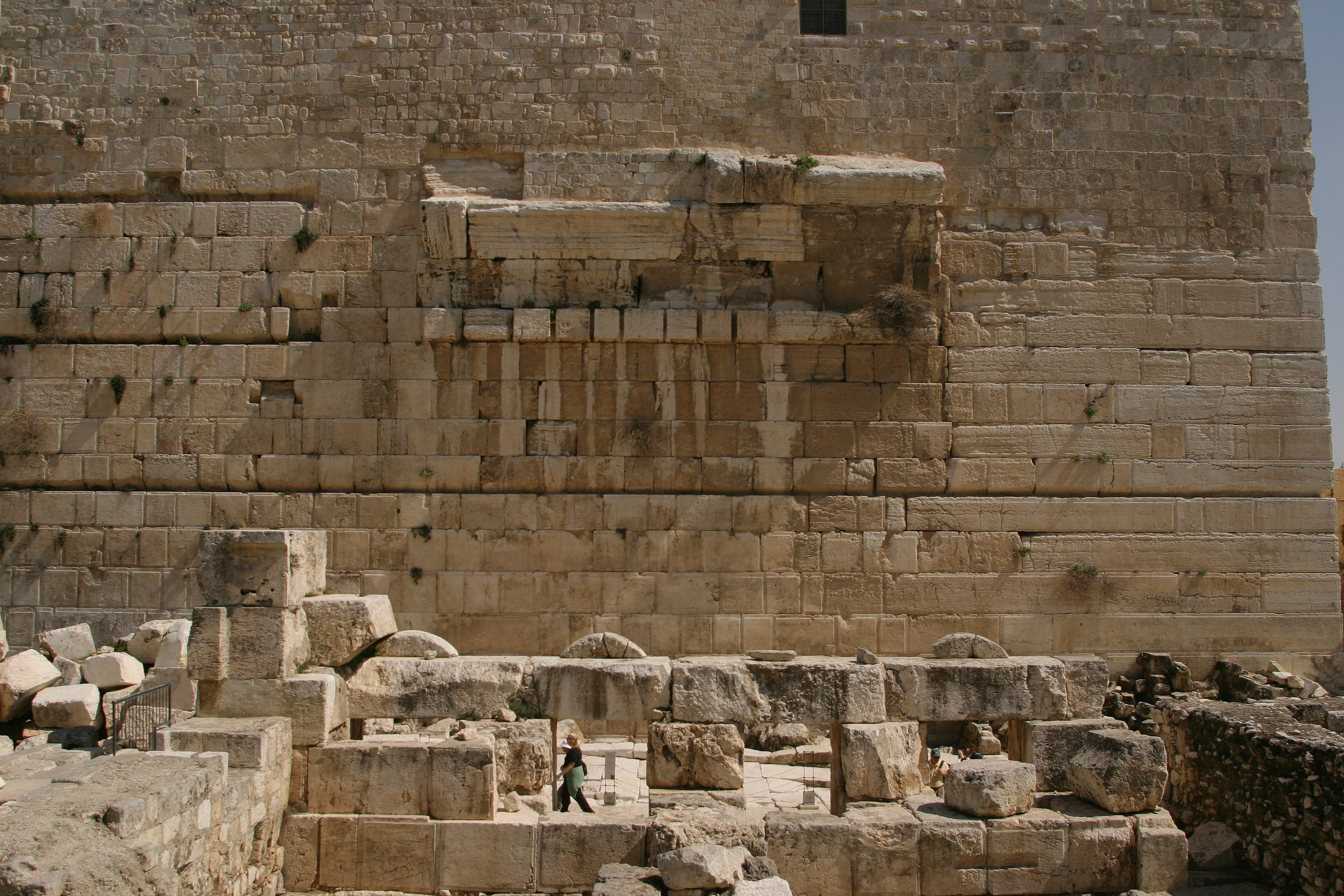
Robinson’s Arch was a stone overpass built for Herod the Great’s expansion of the Second Temple, announced in 20 to 19 BCE. Its staircase linked Jerusalem’s Lower Market with the Royal Stoa across the Tyropoeon street. The stepped street formed part of the Temple Mount’s western retaining wall and crossed the street on a series of additional arches. Heavy traffic to the Royal Stoa, which served commercial and legal functions, helps explain the width of the route. The surviving eastern spring has four stone courses, including impost blocks cut with a dentil pattern.
Findings beneath the street include oil lamps and coins from the first century CE. Coins struck by Valerius Gratus in 17 or 18 CE indicate that the arch and nearby sections of the Western Wall were built later. Recent findings suggest construction may not have been completed until at least twenty years after Herod’s death.
During the First Jewish–Roman War, defenders destroyed the overpass and the viaduct at Wilson’s Arch to make access to the Temple platform more difficult for besieging forces. The arch was destroyed during the events surrounding Rome’s sacking of Jerusalem in 70 CE. Responsibility has traditionally been attributed to Roman legions, though another interpretation says Zealot defenders brought it down.
A Roman milestone made from a staircase handrail bears the names of Vespasian and Titus. It places the arch’s destruction no later than 79 CE. The staircase had also included rounded handrail stones, some of which were found among collapse debris much later.
Frederick Catherwood noticed the remains before Edward Robinson identified them in 1838. Robinson connected them to a bridge described by Josephus and argued that they demonstrated the antiquity of Jerusalem’s walls. His identification gave the arch its present name and brought it into discussions of ancient access to the Temple Mount.
Charles Warren investigated the remains from 1867 to 1870. Benjamin Mazar’s excavations from 1968 to 1977 established that the western pier supported a single great arch. Further excavations directed by Ronny Reich and Yaacov Billig from 1994 to 1996 uncovered much of the collapse debris, including staircase and handrail stones.
The arch carried a stepped street over the Tyropoeon street toward a gate of the Royal Stoa complex. The route crossed seven additional arches, with six vault-supporting piers decreasing in height toward the south. Fragments suggest the gate at the top was five metres wide, but do not establish whether it had one, two, or three openings.
A monumental building was associated with the western pier, and Mazar suggested it may have been Jerusalem’s archives. Four hollow spaces at the pier’s base may have been shops opening onto the ancient street. These remain possibilities rather than established identifications.
In August 2004, a nearby prayer site was inaugurated for services by Reform and Conservative groups and other movements, including Women of the Wall activists. The area is also known as Ezrat Yisrael, or the Masorti Wall. Some groups use part of the area adjacent to the Western Wall worship area for prayer.
In April 2013, Nathan Sharansky proposed renovating the area at the foot of the arch for worshippers’ access at all hours. A prayer platform was completed in August that year with all-hours access. In 2018, Dan Bahat petitioned the High Court to stop construction, arguing that it could destroy archaeological evidence of the destruction in 70 CE. The prayer location has been criticized by Reform and Women of the Wall activists, who say archaeological restrictions limit access and worship, and that they are treated as second-class citizens and excluded from the Western Wall plaza. The area’s use for non-Orthodox services has also made it a focus of disputes over religious access and the status of worship at the Western Wall.
Listen to this audio guide in the app
The website shows the text and photos. The audio guide, map and nearby places are in the free Hotspot app.
Download free on Google Play