
Międzyrzecz Castle
Miedzyrzecz, Poland
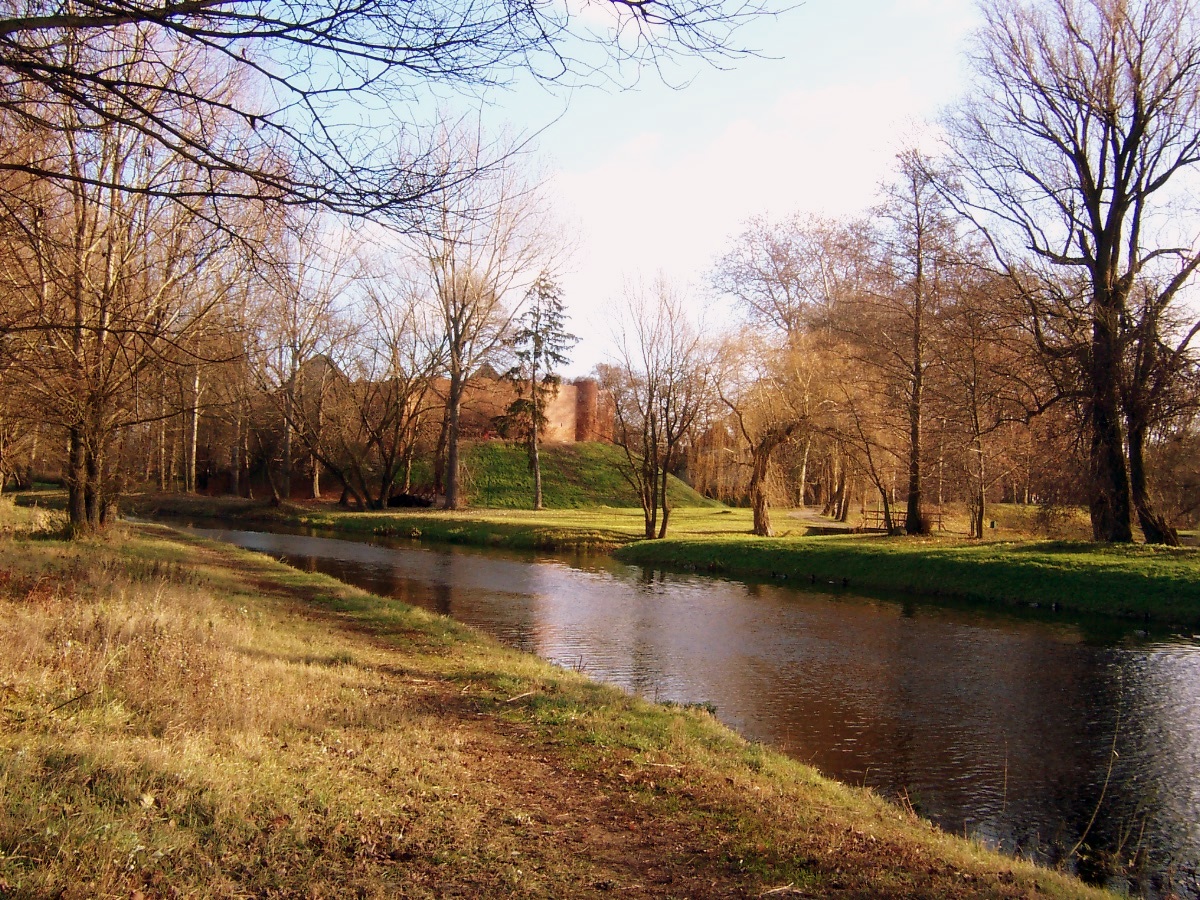
The Piast Royal Castle in Międzyrzecz is a medieval defensive ruin whose brick perimeter walls King Casimir III the Great ordered built around 1350. It occupies an artificial hill between the Obra and Paklica rivers, on a site fortified since the eighth century. A defensive settlement stood here in the eighth century, followed by a Slavic wooden stronghold in the ninth. After the area joined the Polish state in the first half of the tenth century, the stronghold was rebuilt repeatedly during the tenth and eleventh centuries. In the thirteenth century, it served as the administrative and military center of the Międzyrzecz castellany.
The stronghold endured a succession of attacks. Pomeranians occupied it in the mid-eleventh century, and Bolesław III Wrymouth retook it in 1094 after a siege. In 1157, the garrison abandoned and burned the site during Frederick Barbarossa’s intervention. Otto VI of Brandenburg attacked Międzyrzecz in 1269, burning the town and outer settlement, but the stronghold withstood the siege.
Castle construction began in the late thirteenth or early fourteenth century with a masonry gate and probably a keep. Casimir III ordered the perimeter walls around 1350, and brickwork continued until about 1380. The irregular plan followed the ridge of earlier earthworks, while a moat supplied by the Obra, marshes, and smaller towers helped protect the site.
The castle served as a base during the Greater Poland civil war from 1382 to 1385. In 1474, troops of John II the Mad and Matthias Corvinus temporarily took it after castellan Sędziwój Żydowski betrayed the stronghold. Its original eastern entrance stood beside a large cylindrical keep and had a drawbridge; remnants of two smaller towers survive.
On 14 October 1520, mercenaries commanded by Wolf von Schönburg captured the castle after artillery bombardment during the Polish–Teutonic War. Reconstruction continued until 1574, moving the entrance to the eastern wall’s center and adding a Renaissance gate tower. Two cylindrical artillery bastions, fitted with gunports and roof terraces, strengthened the eastern defenses.
The main castle house had four masonry storeys and an attic with eight rooms for soldiers. Residential, storage, and service buildings filled the interior, while the outer ward included stables, a bathhouse, brewery, powder mill, carriage house, and storehouses. In 1574, Henry III of Valois stayed at the castle while travelling from France to Kraków to take the Polish throne.
Swedish forces damaged and devastated the castle in 1655. Rebels briefly occupied it during the Lubomirski Rokosz, and the fortress later ceased to suit the starosts as a residence. They built a manor house beside the ruins in 1719; by the mid-eighteenth century, some castle rooms provided accommodation for the starost’s servants.
After the Second Partition of Poland, Girolamo Lucchesini bought the castle complex, manor buildings, farm, and park. Local landed and patrician families later owned the property. The castle interiors served хозяй хозяй purposes, while vineyards occupied the southern slopes.
After 1945, the complex was assigned to museum use. Archaeological research took place from 1954 to 1958, followed by conservation work in the 1950s and 1960s to secure the structure as a permanent ruin. The surviving gatehouse was reconstructed in 1975 to match the model of its eighteenth-century predecessor, destroyed in 1945.
The surviving horseshoe-shaped walls enclose about 1,200 square metres. The former starost residence and manor outbuilding beside the castle now house museum displays, while the southern bastion contains a torture chamber exhibition. The castle and manor-and-park complex became a Monument of History on 13 November 2024. The Piast Royal Castle is part of the Międzyrzecz Museum Complex, whose neighboring historic buildings house archaeological, historical, artistic, and ethnographic displays. Its collections include seventeenth- and eighteenth-century coffin portraits, heraldic and inscription boards, sacred sculptures, militaria, old prints, coins, and local folk-culture exhibits.
Listen to this audio guide in the app
The website shows the text and photos. The audio guide, map and nearby places are in the free Hotspot app.
Download free on Google Play