
Theater an der Wien
Vienna, Austria
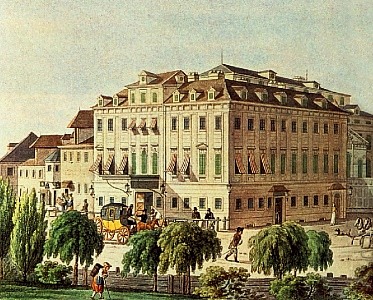
The Theater an der Wien opened in 1801 after thirteen months of construction. Emanuel Schikaneder and the merchant Bartholomäus Zitterbarth pursued the project after financial trouble struck the nearby Freihaustheater. Zitterbarth acquired the property in 1799, and Emperor Francis the Second confirmed the building permit on 3 April 1800. The theatre opened on 13 June 1801 in the Empire style. Its Papageno Gate, made by sculptor Jacob Schroth of Pest, depicts Schikaneder as Papageno with his younger siblings.
From 1803 to 1804, Ludwig van Beethoven lived for a time in a rear wing while composing his opera Leonore. The theatre hosted the first public performances of his Second Symphony in 1803 and Third Symphony in 1805. In 1808, the theatre presented the first public performances of Beethoven’s Fifth and Sixth Symphonies and his Fantasia for Piano, Chorus and Orchestra. On 9 January, it also staged Gluck’s Armide for Emperor Francis the Second, his newly married wife Maria Ludovika Beatrix of Modena, and their family.
Franz Pokorny acquired the theatre in May 1845 and took over its management. During the 1848 revolution, it was renamed the National-Theater an der Wien, while financial difficulties brought the dismissal of its opera staff. After Pokorny died, his son Alois took charge. The theatre closed in March 1862, and Alois’s bankruptcy was accepted in May. Its ownership and management later passed through numerous individuals and groups.
During the Golden Operetta Era, the theatre became a major venue for works by Johann Strauss and Carl Millöcker. Strauss’s Die Fledermaus premiered there in 1874, followed by Franz Lehár’s The Merry Widow in 1905. After the Second World War, the bomb-damaged Vienna State Opera used the building as temporary premises. The City of Vienna acquired the theatre from the Marischka family in 1960, and it reopened as Theater an der Wien on 28 May 1962.
From 1962, the theatre also served the Vienna Festival during summer months. Mozart opera performances under conductors Karl Böhm and Josef Krips became renowned, and some were documented on recordings. Peter Weck became intendant in 1983, as the theatre developed German-language musical theatre. On 24 September that year, Cats received its German-language premiere there. In the early 1990s, Elisabeth became a long-running hit, eventually attracting more than eight million visitors worldwide.
In 2006, under intendant Roland Geyer, the theatre shifted from musical theatre toward opera, particularly Viennese Classicism. It became Vienna’s third opera house, with an inauguration concert conducted by Plácido Domingo. Since 2006, its programme has included Baroque opera, Viennese Classicism, and works from the twentieth and twenty-first centuries. Productions use different orchestras, including the Vienna Symphony, the Radio Symphony Orchestra Vienna, and Concentus Musicus Wien.
The theatre uses a stagione system, presenting productions in blocks rather than operating as a repertory theatre with its own ensemble. Its youth education programme began in 2007 as Jugend an der Wien, and the Vienna Chamber Opera has been presented there since September 2012. In 2010, the Hölle revived the theatre’s tradition of literary-musical cabaret, which had run from 1906 to 1930. Georg Wacks led an annual revue there until 2022.
A new production of Benjamin Britten’s Peter Grimes, directed by Christof Loy and conducted by Cornelius Meister, received the International Opera Award in 2016. The production of Cublai, gran kan de’ Tartari received an award in the Rediscovery category at the 2024 International Opera Awards. Stefan Herheim became intendant with the 2022/23 season, when the music-theatre education programme was renamed TaWumm! The theatre underwent comprehensive renovation from March 2022 to October 2024, using Hall E in the MuseumsQuartier as a temporary performance venue.
The theatre now has 1,129 seats and 50 standing places. Following the renovation, barrier-free access extends throughout the building from the Hölle to the third tier. Its operetta history includes the Silver Era, when Franz Lehár was a prominent figure. The theatre also hosted the Nestroy Awards in 2000 and 2007.
Listen to this audio guide in the app
The website shows the text and photos. The audio guide, map and nearby places are in the free Hotspot app.
Download free on Google Play